Overview of Facility Siting in Relevance to the PHA Process
Introduction
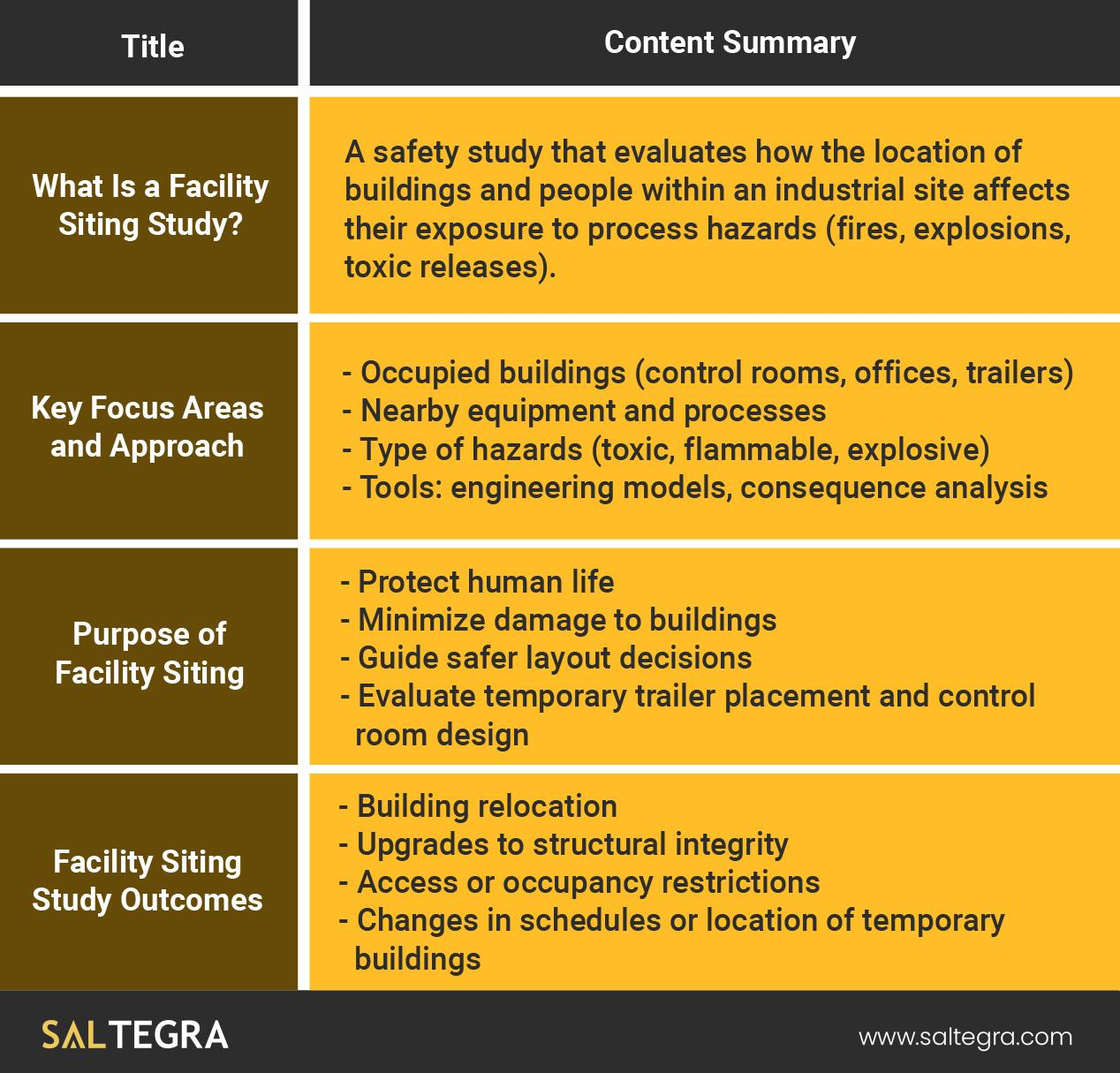
A Facility Siting Study evaluates how the physical arrangement of equipment, buildings, and people within an industrial site can influence the severity and consequences of a process incident. It determines whether occupied structures—such as control rooms, administrative offices, maintenance shops, or contractor trailers—are at risk from fires, explosions, or toxic releases originating from nearby processes.
This study examines the relationship between building locations and potential process hazards in greater detail. It goes beyond layout efficiency and focuses on whether people in those buildings could be affected by events like explosions or gas releases. Using engineering data, process knowledge, and modeling tools, the study identifies areas where people might be at risk and provides options to reduce that risk—whether through relocation, design upgrades, or changes in how and when buildings are used.
Purpose of Facility Siting
The purpose of facility siting is to protect life and minimize damage by ensuring that people and structures are located at safe distances from potential hazards. These hazards could include high-pressure equipment failures, vapor cloud explosions, or the release of flammable or toxic substances.
The facility siting assessment goes beyond compliance. It supports key safety decisions, such as whether a temporary trailer can be placed near a unit during a turnaround, or whether the control room design can withstand overpressure from a nearby vessel rupture.
Importantly, facility siting should not be viewed as a one-time activity. It should be revisited during plant modifications, major turnarounds, or when there are changes to the occupancy of buildings within the site.
Key Standards and Regulatory Requirements
Several regulations and industry standards require or strongly encourage the integration of facility siting into the risk management process.
OSHA PSM Standard (29 CFR 1910.119)
OSHA requires that facility siting be addressed during Process Hazard Analyses. Section (e)(3)(v) emphasizes the importance of considering building location and occupancy when assessing process hazards.
API Recommended Practice 752
This standard guides the evaluation of permanent buildings for blast, thermal, and toxic exposure. It includes risk criteria such as tolerable overpressure levels (typically 0.5 to 1 psi) and design considerations for control rooms.
API Recommended Practice 753
This document focuses on portable buildings, such as trailers, often used during construction or maintenance work. It includes criteria for trailer location based on zone risk ranking and provides occupancy limitations for high-risk areas.
CCPS Guidelines for Facility Siting and Layout
The Center for Chemical Process Safety provides methodologies for siting studies that incorporate qualitative screening, quantitative modeling, and structural performance assessments. These guidelines support consistency in decision-making and alignment with best practices.
Meeting these facility siting standards helps ensure that building locations and designs are not only code-compliant but also protective of human life in worst-case scenarios.
Facility Siting in the PHA Process
Facility siting is a key component of a well-rounded Process Hazard Analysis. While a typical PHA focuses on identifying process deviations—such as overpressure, reverse flow, or high temperature—it may not fully address the real-world consequences unless facility layout and occupancy are included in the discussion.
By integrating facility siting assessments into the PHA process:
- Teams can model potential fire, explosion, or toxic release scenarios and evaluate their impact on occupied structures.
- Risk scenarios are made more tangible, as they include not just process outcomes, but who might be exposed and where.
- The facility layout can be analyzed to determine whether a change in occupancy or building location might reduce risk more effectively than equipment modifications alone.
Practical Example
One example from our field experience involved a refinery preparing for a major turnaround. A large trailer complex for contractor teams was placed near a hydroprocessing unit. The PHA team identified a scenario where a release from the unit could result in a vapor cloud explosion. Using consequence modeling, we calculated the overpressure at the trailer to be over 1.5 psi—well above the safe threshold for non-reinforced portable structures.
The solution was not complicated. We recommended relocating the trailer complex an additional 60 meters away, beyond the 1 psi contour. The move had a minimal cost impact and zero impact on project timing, yet significantly improved the safety of more than 40 workers who would have otherwise been in a high-risk zone.
This is the power of combining practical experience with technically sound facility siting studies.
Common Findings in Facility Siting Assessments
Some of the most frequent findings during facility siting assessments include:
- Trailers located within zones that exceed acceptable blast or heat flux levels.
- Control rooms not designed to withstand anticipated overpressures.
- Building HVAC systems without gas detection or isolation capabilities.
Lack of coordination between building occupancy schedules and high-risk operational activities.
Recommended mitigations can range from relocating buildings and installing blast-resistant windows to revising occupancy rules during certain operations or adding toxic gas alarms tied to automatic HVAC shutdown.
Balancing Technical Rigor and Operational Reality
It’s common for companies to hesitate when faced with recommendations that may require construction changes or operational restrictions. Balancing safety with practicality is a key aspect of our approach at Saltegra. We align our facility siting studies with standards such as API RP 752 and 753, while also ensuring that the recommendations are realistic and achievable.
For instance:
- Not every control room needs to be blast-hardened. We evaluate actual risk exposure before making that call.
- Temporary trailers may still be used near process units if occupancy can be controlled and timed properly.
- Building relocation is not always the only option—other mitigations may provide acceptable risk reduction.
How Saltegra Can Help
- At Saltegra Consulting, we treat facility siting as a vital part of your overall process safety strategy. Whether you’re conducting a full PHA, preparing for a turnaround, or planning a new unit, our team provides:
- Site-specific consequence modeling for fire, explosion, and toxic release scenarios.
- Clear risk ranking and exposure analysis using recognized facility siting standards.
- Recommendations that are defensible, practical, and tailored to your site’s operations.
- Integration of findings into PHA, LOPA, and emergency planning activities.
We also help you document and close out recommendations—something many companies struggle with. Our goal is not just to check a box, but to make sure your people are safer at work.
Conclusion
Facility siting is where engineering meets real life. It bridges technical risk modeling with practical decisions about where people should work, rest, or take shelter. When done correctly, a facility siting study transforms your PHA from a theoretical exercise into a comprehensive safety evaluation that incorporates the human element.
At Saltegra Consulting, we help companies take the next step in process safety maturity by integrating facility siting assessments with their hazard analysis efforts. Whether you’re a refinery, chemical plant, terminal, or manufacturing site, we offer the tools and expertise to ensure your siting decisions are safe, compliant, and cost-effective.
Let’s work together to make your facility safer—starting with where your people are.