
Understanding Human Factors and How It Affects a PHA
Introduction
Human factors refer to the ways in which people interact with equipment, systems, and procedures in the workplace. These include physical, cognitive, organizational, and environmental influences that affect how work is performed, especially under pressure, fatigue, or unfamiliar conditions.
In industrial settings, these factors play a key role in safety-critical tasks like operating valves, responding to alarms, or following startup procedures.
In the context of process safety, human factors are not limited to operator error. They include poor interface design, missing procedures, fatigue from shift work, lack of training, confusing alarms, or even a workplace culture where workers hesitate to report near misses. These conditions, if not addressed, can create vulnerabilities that lead to incidents—even when all the equipment is working as designed.
Why Human Factors Matter in a PHA
During a Process Hazard Analysis (PHA), teams focus on identifying process deviations, their causes, and their consequences. While mechanical failures and design flaws often get attention, human actions—intentional or unintentional—can be just as critical.
Human factors influence how controls are operated, how procedures are followed, and how deviations are detected and responded to. A well-designed system can still fail if the people operating it are not set up for success.
For example, a simple mistake like opening the wrong valve might not be due to incompetence, but because the valves were poorly labeled, looked identical, or were placed too close together. If a PHA doesn’t take these conditions into account, it might overlook real risks.
Common Human Factor Issues in Industrial Settings
Here are some examples of human factor concerns we often identify during PHAs or related studies:
- Alarm overload: Operators are flooded with alarms during an upset, making it hard to identify which ones require immediate action.
- Poor control room layout: Critical controls are placed far from the operator’s line of sight or physical reach.
- Inadequate procedures: Written procedures are too complex, outdated, or unavailable during emergencies.
- Workload and fatigue: Staff working long shifts or back-to-back days are more prone to errors during routine or emergency operations.
- Interface design: Screens or panels display too much information, or use unclear symbols, slowing down operator response.
- Training gaps: Contractors or junior staff may not fully understand site-specific hazards or emergency protocols.
These issues often contribute to incidents and near misses, yet they can be addressed through proper integration of human factors into the PHA process.
Integrating Human Factors into the PHA Process
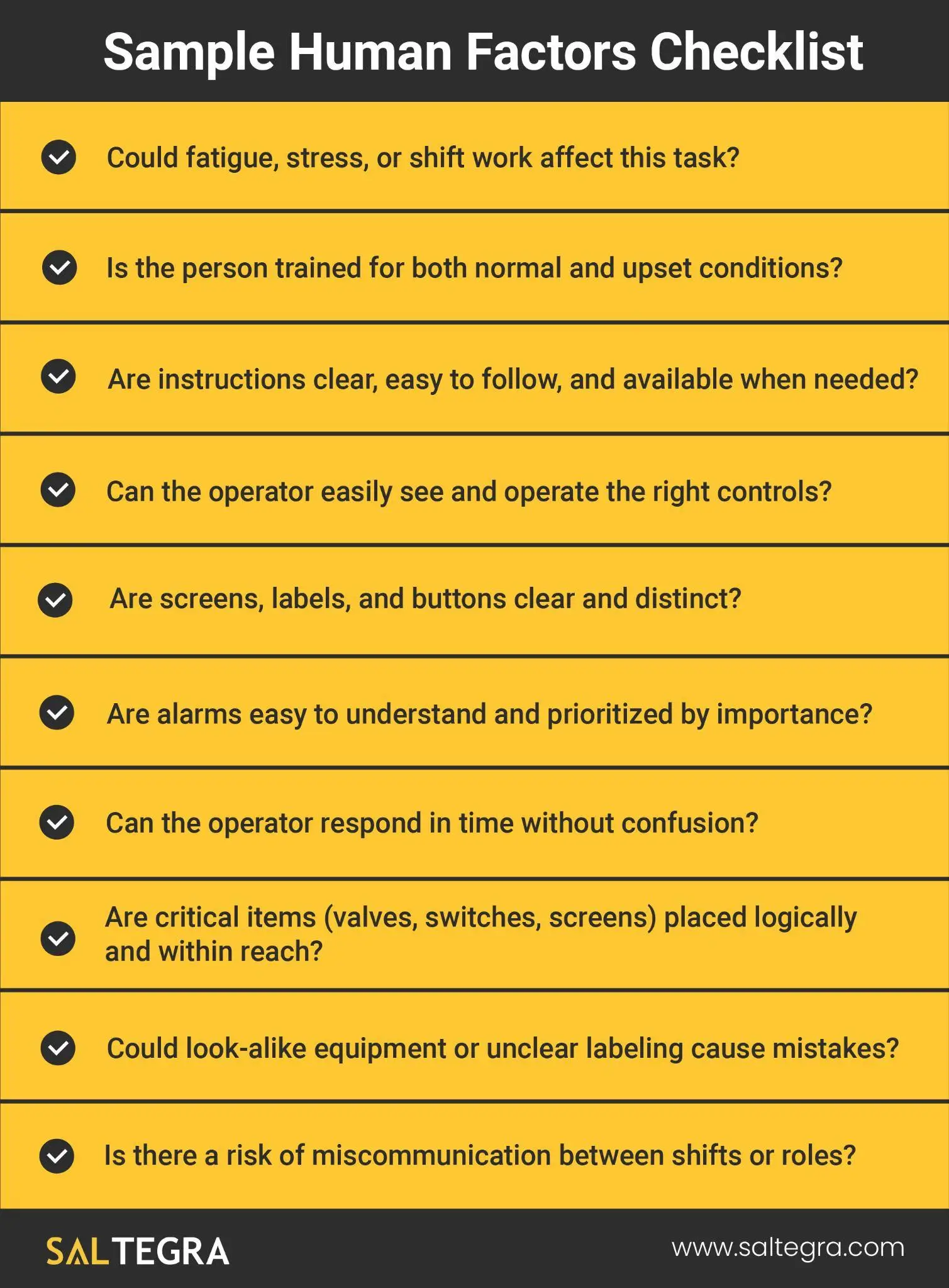
Incorporating human factors into PHA does not require a complete overhaul of the method, but it does require a shift in how the team considers risks. One of the most effective ways to do this is by using a Human Factors Checklist during PHA workshops.
This checklist helps guide the team to think beyond equipment and into the realities of how people operate the process. Typical checklist items may include:
- Are operator actions critical to preventing or mitigating this scenario?
- Is the control interface easy to understand and use under stress?
- Are alarms prioritized and configured to support timely operator response?
- Are procedures clear, accessible, and updated?
- Could fatigue or shift work impact performance during this deviation?
- Is training sufficient for normal and abnormal conditions?
- Are tasks affected by time pressure, workload, or communication gaps?
The checklist can be applied at each node or scenario, or used during a focused review session at the end of the PHA. In our experience at Saltegra Consulting, integrating this step improves the quality of recommendations and reveals risks that would otherwise go unnoticed.
Practical Example: Operator Response During a Startup
In a recent PHA for a batch chemical plant, the team reviewed a node involving startup of a reaction vessel. The process required the operator to monitor temperature rise and manually close a valve within 30 seconds to prevent a runaway.
From a design perspective, everything was functional. But applying a human factors checklist raised a concern: the control panel required navigation through four screens to reach the valve indicator, and the audible alarm was the same tone used for non-critical warnings elsewhere in the facility.
This led to a recommendation not only to automate the shutdown but also to reconfigure the alarm hierarchy and simplify the screen navigation. The fix was simple but had a significant impact on reducing reliance on fast human response during a time-critical event.
Challenges in Addressing Human Factors
Human factors are sometimes dismissed as “operator error” and viewed as outside the scope of engineering solutions. In reality, most human errors are the result of flawed system design, unclear expectations, or working conditions that don’t support safe behavior.
Addressing these issues requires cross-functional collaboration between operations, safety, engineering, and sometimes HR. It also means going beyond traditional engineering fixes to include training improvements, interface redesigns, procedure rewrites, or workload adjustments.
Saltegra’s Approach to Human Factors in PHA
At Saltegra Consulting, we embed human factors thinking into our PHA facilitation and risk studies. We believe that systems are only as strong as the people operating them, and that design should support those people, not burden them.
Our PHA sessions include structured questions around human error potential, alarm handling, and task complexity. We use practical checklists drawn from CCPS, HSE guidance, and our own field experience. When risks are identified, we recommend both engineering and administrative solutions, whichever best reduces the likelihood of failure.
We also support our clients in closing the loop. That includes helping to rewrite procedures, redesign alarm systems, or review training programs to ensure PHA recommendations translate into real improvements.
Conclusion
Human factors are present in every process, whether acknowledged or not. By including them in the PHA process, companies can better understand how people actually interact with the systems they operate—and where failures might occur even when equipment performs as intended.
A well-executed human factors review, supported by a checklist and team insight, brings a new layer of value to hazard analysis. It not only improves the quality of the PHA but also builds a stronger foundation for operational discipline and long-term safety culture.
At Saltegra, we work with clients to make these insights part of their everyday risk management. If you’re preparing for a PHA or looking to improve how human factors are addressed in your process, we’re here to help you make that connection—between systems, procedures, and the people who make them work. Connect with our team today!