
Why Dust Hazard Analysis (DHA) Matters in Your Risk Prevention Process
Introduction
Dust Hazard Analysis (DHA) is a critical safety process for industries handling combustible dusts. Its importance is demonstrated by historical incidents, grounded in the fundamental science of dust explosions, and codified in standards such as those from the National Fire Protection Association (NFPA). This article provides a verified, source-backed overview of DHA, integrating incident history, explosion principles, and systematic analysis methodology.
Industrial Incidents: The Imperative for DHA
Catastrophic dust explosions have occurred across various industries, causing loss of life, injuries, and extensive property damage. Between 1980 and 2005, the U.S. Chemical Safety and Hazard Investigation Board (CSB) identified 281 combustible dust incidents resulting in 119 deaths and 718 injuries. A notable case is the 2008 sugar dust explosion in Port Wentworth, Georgia, which killed 14 workers and injured dozens more. These events often stemmed from unrecognized hazards, inadequate controls, or poor communication of risks in safety documentation.
The Dust Explosion Pentagon
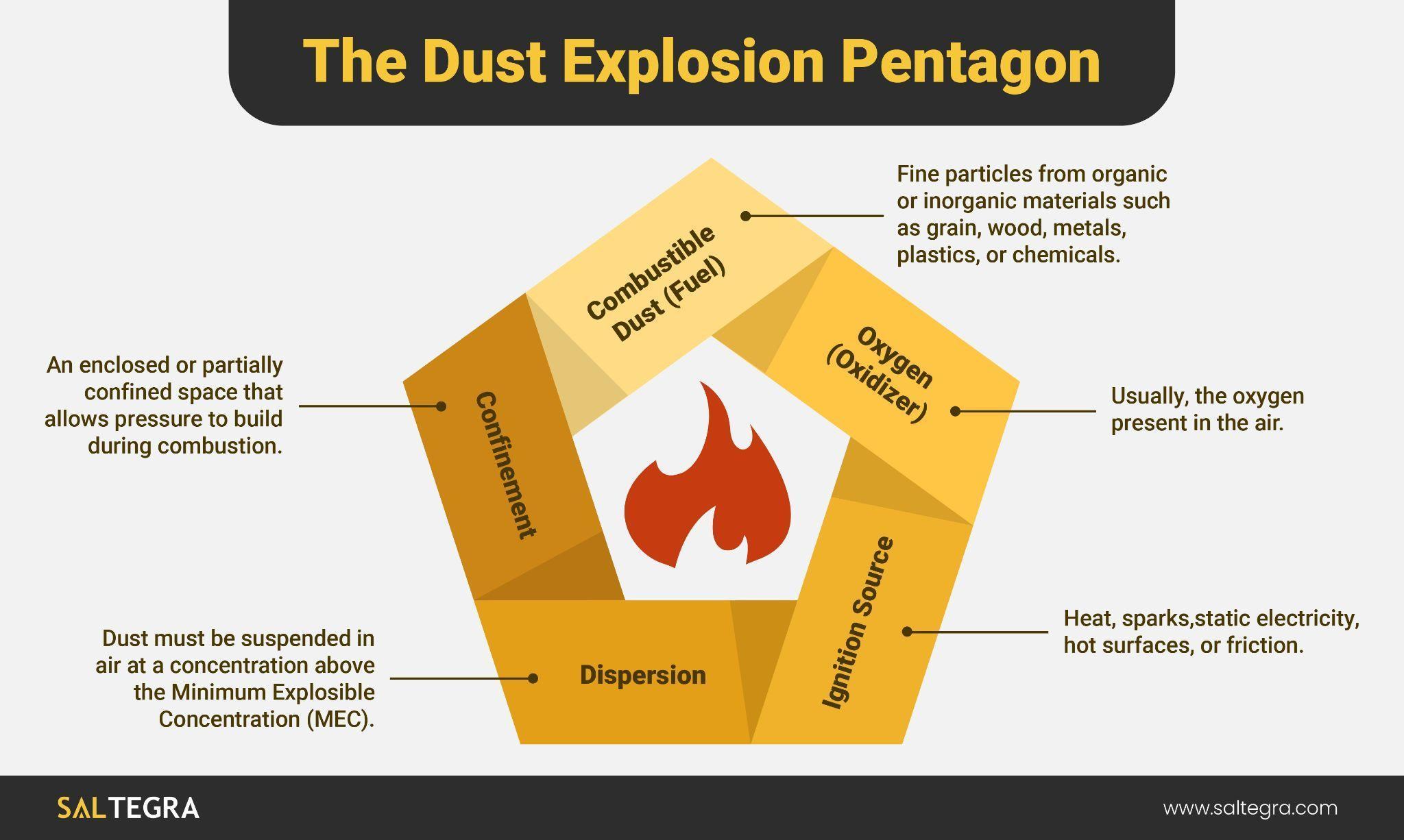
A dust explosion requires five elements, collectively known as the dust explosion pentagon:
- Combustible Dust (Fuel): Fine particles from organic or inorganic materials such as grain, wood, metals, plastics, or chemicals.
- Oxygen (Oxidizer): Usually, the oxygen present in the air.
- Ignition Source: Heat, sparks, static electricity, hot surfaces, or friction.
- Dispersion: Dust must be suspended in air at a concentration above the Minimum Explosible Concentration (MEC).
- Confinement: An enclosed or partially confined space that allows pressure to build during combustion.
If any one of these elements is missing, a dust explosion cannot occur. This model expands on the traditional fire triangle by adding dispersion and confinement, which are specific to dust explosions.
Explosion Sequence and Severity
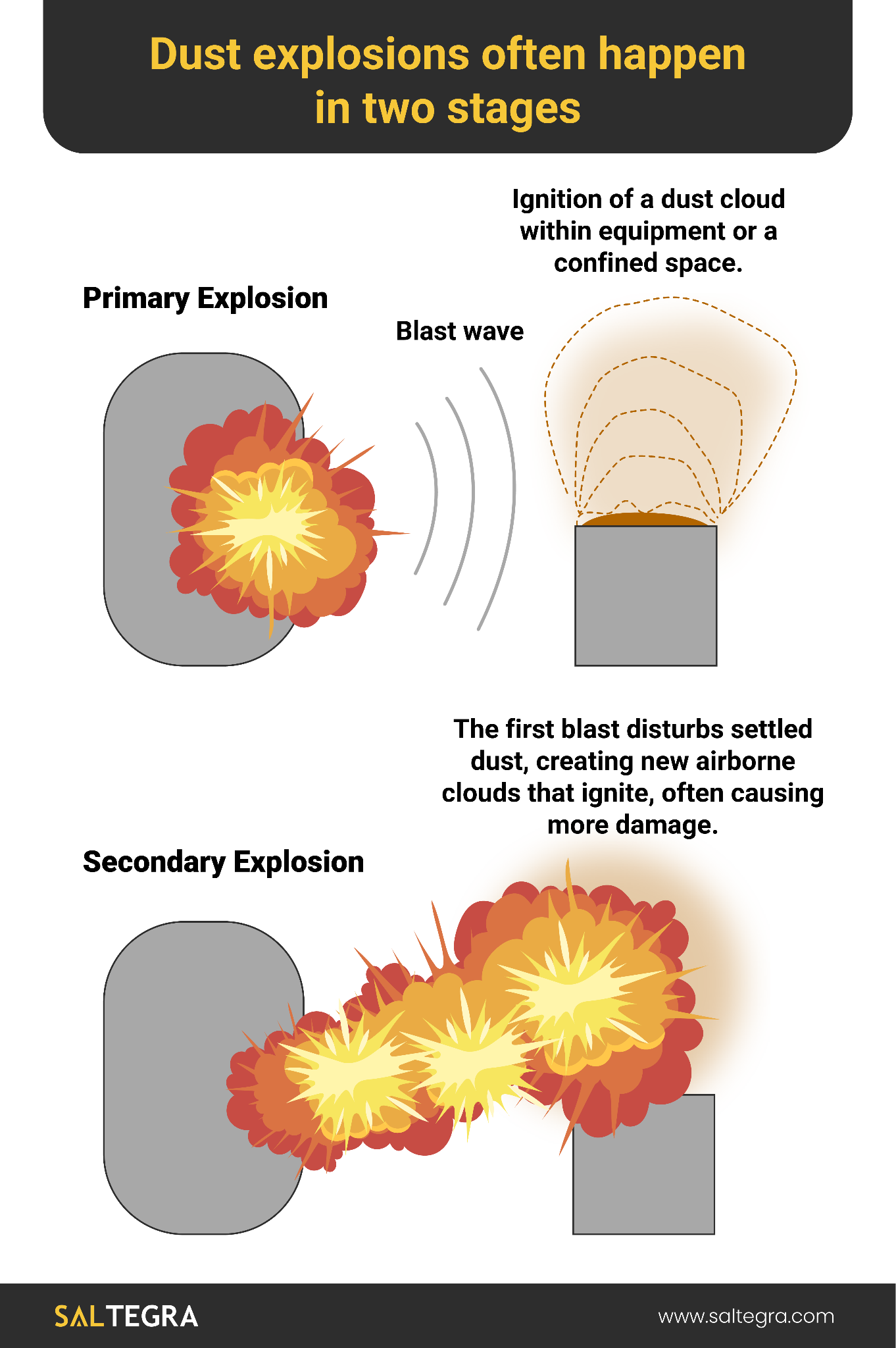
Dust explosions often happen in two stages:
- Primary Explosion: Ignition of a dust cloud within equipment or a confined space.
- Secondary Explosion: The first blast disturbs settled dust, creating new airborne clouds that ignite, often causing more damage.
Severity depends on particle size, dust concentration, chemical properties, and confinement. Even low-energy explosions can cause significant destruction, as seen in incidents involving sugar and powdered milk.
Critical Parameters
- Minimum Explosible Concentration (MEC): The lowest concentration of dust in air that can sustain an explosion.
- Kst Value: A measure of how powerful a dust explosion is. Higher values mean more severe explosions.
- Minimum Ignition Energy (MIE): The slightest spark or heat input needed to ignite a dust cloud.
What is Dust Hazard Analysis (DHA)?
A Dust Hazard Analysis is a structured safety review required by NFPA standards. It helps identify, evaluate, and control fire, flash fire, and explosion hazards related to combustible dust. The process ensures that all dust-related hazards are thoroughly reviewed and that effective safeguards are implemented.
NFPA DHA Requirements
Under NFPA 652: Fundamentals of Combustible Dust, DHA is required for:
- All new processes involving combustible dust.
- Existing facilities, which should have completed their first DHA by September 2020.
- Facilities changing equipment, materials, or processes that affect dust handling.
Key NFPA requirements include:
- Written DHA Report: The DHA must be documented. It should list hazards, existing controls, and any recommended improvements.
- Qualified Personnel: The DHA must be completed or led by someone with proper knowledge of the process and dust hazards.
- Revalidation Every Five Years: Facilities must review and update the DHA every five years or after major changes.
- Deflagration Risk Evaluation: Facilities must assess the risk of a deflagration and the effectiveness of safeguards such as venting or suppression.
- Part of Management of Change (MOC): The DHA must be updated during any MOC process that affects dust hazard conditions.
- Cleaning and Inspection Programs: Facilities must have formal housekeeping and inspection procedures to control dust accumulation.
Facilities must also comply with industry-specific standards when applicable:
- NFPA 61: For agricultural and food processing facilities
- NFPA 484: For combustible metals
- NFPA 654: For general dust environments
- NFPA 655: For sulfur
- NFPA 664: For woodworking operations
These standards provide detailed control measures and guidance tailored to the type of material being handled.
DHA Methodology
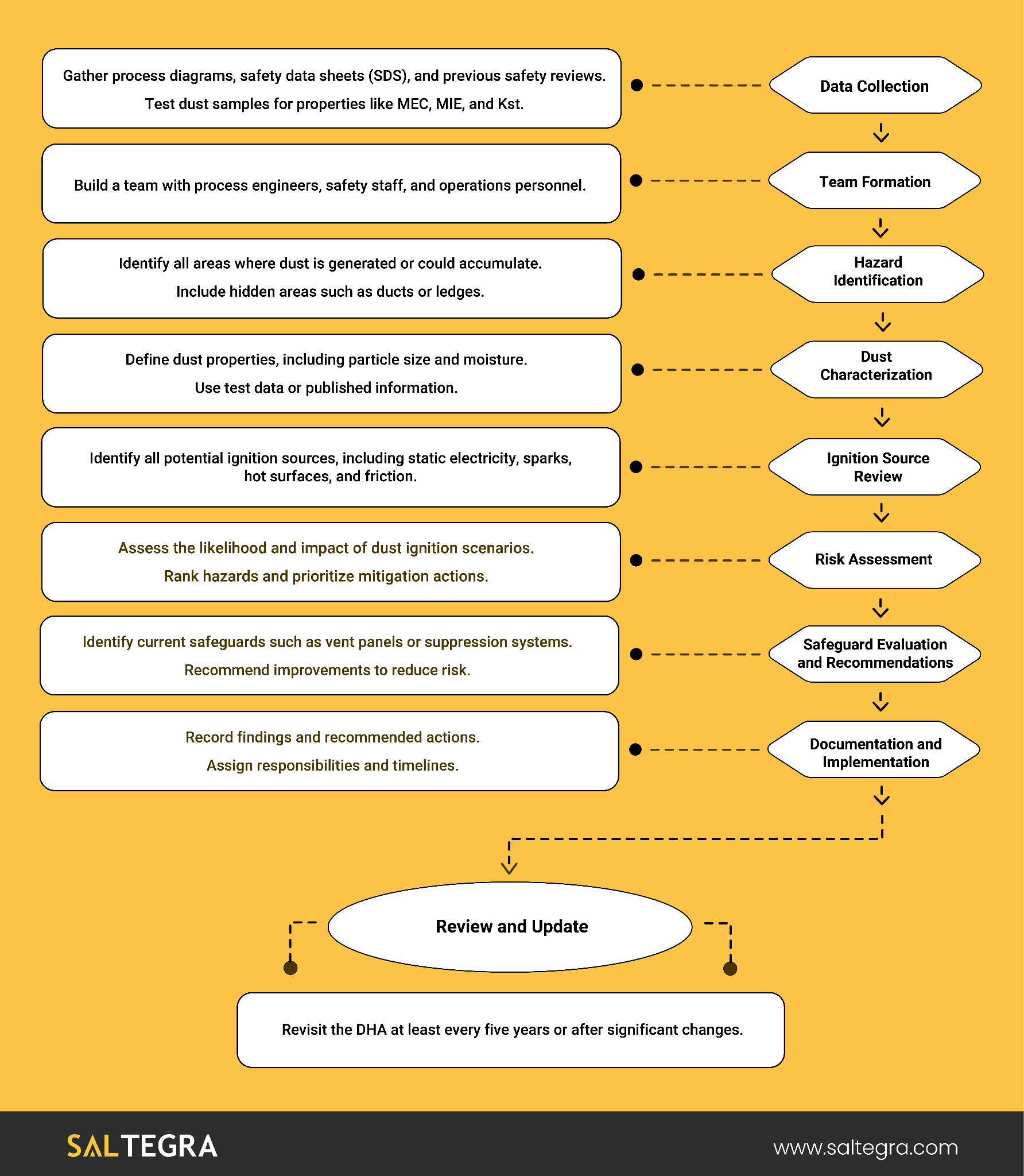
The DHA process combines explosion science with practical risk assessment. Steps include:
1. Data Collection
- Gather process diagrams, safety data sheets (SDS), and previous safety reviews.
- Test dust samples for properties like MEC, MIE, and Kst.
2. Team Formation
- Build a team with process engineers, safety staff, and operations personnel.
3. Hazard Identification
- Identify all areas where dust is generated or could accumulate.
- Include hidden areas such as ducts or ledges.
4. Dust Characterization
- Define dust properties, including particle size and moisture.
- Use test data or published information.
5. Ignition Source Review
- Identify all potential ignition sources, including static electricity, sparks, hot surfaces, and friction.
6. Risk Assessment
- Assess the likelihood and impact of dust ignition scenarios.
- Rank hazards and prioritize mitigation actions.
7. Safeguard Evaluation and Recommendations
- Identify current safeguards such as vent panels or suppression systems.
- Recommend improvements to reduce risk.
8. Documentation and Implementation
- Record findings and recommended actions.
- Assign responsibilities and timelines.
9. Review and Update
- Revisit the DHA at least every five years or after significant changes.
Putting DHA Into Practice
A complete DHA examines each factor in the dust explosion pentagon and determines whether controls are in place and effective. NFPA requirements make sure facilities follow a consistent approach and focus on real risks.
Conclusion
Dust Hazard Analysis (DHA) is a required and effective method for managing combustible dust hazards. Saltegra Consulting supports clients in meeting these requirements through expert DHA facilitation, documentation, and implementation support. Our team ensures each DHA reflects the latest standards, delivers practical risk control strategies, and promotes a safer working environment for all. Contact us today!