
How Often Should You Revalidate Your PHA System? A Guide for Process Safety Leaders
Introduction
Process Hazard Analysis (PHA) is a cornerstone of a robust process safety management system. It systematically identifies, evaluates, and controls the hazards associated with processes involving highly hazardous chemicals. However, the initial PHA is not a one-and-done effort; it must be periodically revisited to ensure its continued effectiveness.
According to the Occupational Safety and Health Administration (OSHA) under 29 CFR 1910.119(e)(6), employers are required to revalidate the PHA at least every five (5) years after the completion of the initial process hazard analysis. This cycle ensures that any changes in processes, equipment, regulations, or lessons learned from incidents are reflected in the risk assessment framework.
Regular revalidation of Process Hazard Analyses (PHAs) enables safety leaders to proactively identify gaps, update safeguards, and maintain regulatory compliance. But how often should you be revalidating your PHA, and which approach should you take?
What Drives the Need for Revalidation?
While OSHA mandates a 5-year revalidation cycle, several other key drivers might necessitate an earlier or more frequent review:
Process Changes
Changes to the process, materials, procedures, facilities, or equipment require careful review and consideration. Management of Change (MOC) systems are used to evaluate associated hazards and to document changes, helping ensure that process safety information remains current to support existing safeguards. However, even with the MOC system, these changes should still be reviewed individually and collectively to ensure the hazard assessments are accurate.
Sometimes, changes occur without going through the MOC process. These can compromise the original process design and introduce unrecognized risks. All these changes eventually accumulate and can create hazards that may not have been identified during the review of a single change.
Quality of Previous PHA
Company policies and government regulations outline the requirements for a PHA. However, gaps and deficiencies can occur if these analyses are not properly executed. Common issues include using an inexperienced or insufficiently trained PHA team, or applying inappropriate methods, such as relying solely on the What-if technique for complex systems. These shortcomings can lead to incomplete hazard identification and undermine the effectiveness of the PHA.
Operating History & Research
New insights may emerge since the last PHA, driven by operating experience or R&D prompted by incident investigations, near-miss reports, or process improvement initiatives. These findings can change previous assumptions about risks and safeguards. Revalidation allows the integration of new knowledge into the existing PHA.
Previous PHA Recommendations
The revalidation team should review the recommendations from the previous PHA to check if they were properly addressed. Ideally, all recommendations should be closed before the next revalidation, but they sometimes remain open. In that case, the team should discuss not how to resolve them but how to understand why they stay open or why similar recommendations resurface.
Reviewing these recommendations also helps verify whether they were implemented correctly, using the Management of Change (MOC) system. If there’s no MOC documentation, these changes are considered uncontrolled and must be reviewed. This process ensures that safety measures in the PHA are updated based on the recommendations.
Regulatory & Company Requirements
Company policies and government regulations mandate the need, frequency, and scope of the revalidation. Changes to these policies or regulations can prompt the need for a new revalidation.
Decommissioning of Process Equipment
The decommissioning process introduces unique risks not present during normal operations. This may require a new PHA instead of a revalidation, depending on the complexity of the decommissioning work.
The Three Approaches to PHA System Revalidation
Depending on the scope and resources, companies can choose from three main approaches to Process Hazard Analysis (PHA) revalidation:
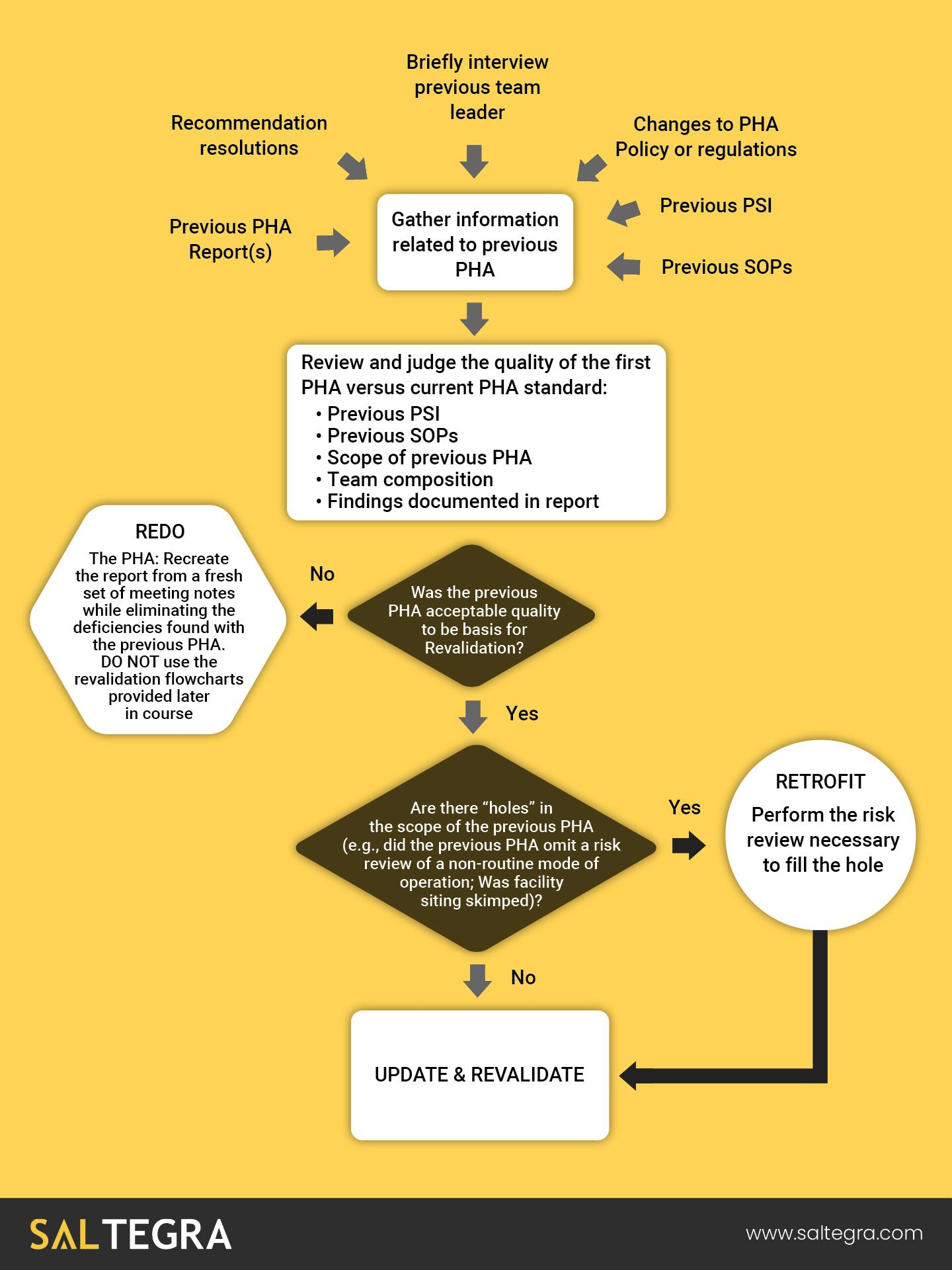
Update & Revalidate
This PHA revalidation approach involves updating the existing PHA to reflect any process changes and incident learnings that have occurred since the previous PHA. Then, these process changes are discussed.
If the facility has both a reliable and well-implemented MOC system and the original PHA was thorough, well-documented, and completed by a qualified team, then this method will be more streamlined. Process changes are discussed on their corresponding node, and their effect on the deviation, cause, consequences, and safeguards documented on the previous PHA is analyzed.
For incidents, teams should first determine whether the event was already covered in the original PHA. If it was, they must evaluate whether the safeguards were adequate. If the incident introduces a previously unidentified hazard, the team must apply standard PHA methods to analyze the scenario and update the PHA accordingly.
- Evergreen Approach
The evergreen approach is the simplest method of revalidation, exclusive only to companies with mature PHA systems and good staff continuity. Under this approach, updates to the baseline PHA are made immediately following each MOC or on a regular basis (e.g., monthly). As a result, the PHA remains up to date. This approach requires continuity of PHA team leaders between unit-sized PHAs and mini-PHAs for changes (MOCs), as well as a high-quality and thorough baseline PHA.
Retrofit (Update and Revalidate)
Retrofits are used when the previous PHA was incorrectly applied or incomplete in risk management. Still, they can be corrected, supplemented, or enhanced by the new PHA team without the need to start over. Some examples of PHAs requiring retrofits:
- Fails to consider required elements like human factors
- Overlooked operational modes
- Missing hazard reviews for certain equipment or subunits
- Absence of a facility siting analysis
Redo
A redo involves starting from scratch, much like performing an initial PHA. Redos are done when the methodologies of the previous PHA were incorrectly applied and cannot be corrected. This scenario may be due to wrong team composition for the initial PHA, a methodology that is too simplified for a complex system, or major changes in regulatory requirements or internal policies.
Conclusion
Revalidating your PHA system isn’t just a regulatory checkbox—it’s a vital part of managing evolving process risks. By understanding the drivers of revalidation and choosing the right approach, process safety leaders can protect their workforce, assets, and the environment more effectively.
Start by reviewing your last PHA date and scope. Are you nearing the 5-year mark? Has your process changed significantly since then? Engage your safety team today to plan your next Process Hazard Analysis (PHA) revalidation and ensure continuous process safety excellence.
For expert guidance in revalidating your Process Hazard Analysis (PHA), contact us at Saltegra Consulting LLC. We have a team of engineers and safety experts who can help you identify gaps and develop solutions to enhance safety in your industry.