Understanding QRA and Its Role in the Safety of High-Risk Industries
Introduction
In high-risk industries, managing safety requires more than general assessments. Quantitative Risk Assessment (QRA) utilizes numerical models to evaluate hazards, facilitating data-informed decisions and effective risk management. This method is particularly crucial in sectors such as oil and gas, chemicals, nuclear energy, and pharmaceuticals, where failures can have severe consequences. QRA supports safety, compliance, and operational resilience by quantifying risk likelihood and severity.
What Is Quantitative Risk Assessment (QRA)?
Quantitative Risk Assessment (QRA) is a data-driven method that uses numerical values to evaluate the likelihood and impact of potential incidents. By applying mathematical models, QRA provides a clear understanding of hazards and enables objective comparison of risk scenarios and control measures. Unlike qualitative approaches such as Process Hazard Analysis (PHA), which use general descriptors, QRA offers the precision needed for critical decisions in complex, high-risk environments.
QRA is widely used across various high-risk industries, including:
- Petrochemical operations, which support the evaluation of explosion and toxic release risks
- Pharmaceutical manufacturing, for analyzing contamination control and product safety
- Nuclear power facilities, to assess the probabilities of radiation exposure and core damage
- Aerospace engineering, for calculating component failure rates and overall system reliability
- Maritime transport, to evaluate collision risks and environmental impact scenarios
- Chemical production, for modeling containment failures and process-related hazards
Key Components of QRA
Hazard Identification
Every quantitative risk assessment begins with a thorough hazard identification process, utilizing methods such as HAZOP, FMEA, and What-If analysis. These techniques help uncover possible failure modes and scenarios. A clear understanding of potential risks at this stage ensures that the quantitative assessment captures all credible threats, forming a solid foundation for effective analysis.
Consequence Analysis
Consequence analysis models the potential outcomes of identified hazards using software tools that simulate fire spread, explosions, toxic releases, or radiation. These models take into account physical properties, weather, and population distribution to estimate impact zones and exposure levels. This detail supports informed decisions and thorough risk evaluations.
Frequency Assessment
This step estimates how often hazardous events might occur, usually in events per year. Methods include fault tree analysis, event tree analysis, and historical data. To account for uncertainty, analysts use advanced techniques like Bayesian analysis and Monte Carlo simulations, producing realistic frequency estimates with confidence intervals.
Risk Calculation and Evaluation
The risk calculation phase integrates the severity of consequences with the likelihood of occurrence to produce measurable risk values. Several key metrics are commonly used:
- Individual Risk refers to the probability that a person at a specific location will experience a fatality due to a hazardous event.
- Societal Risk examines the frequency and severity of incidents involving multiple casualties, often represented through F-N curves.
- Economic Risk captures the potential financial losses, expressed in monetary terms, resulting from identified scenarios.
- Environmental Risk quantifies the impact of hazardous events on natural systems, sometimes using indicators such as Environmental Impact Units (EIUs).
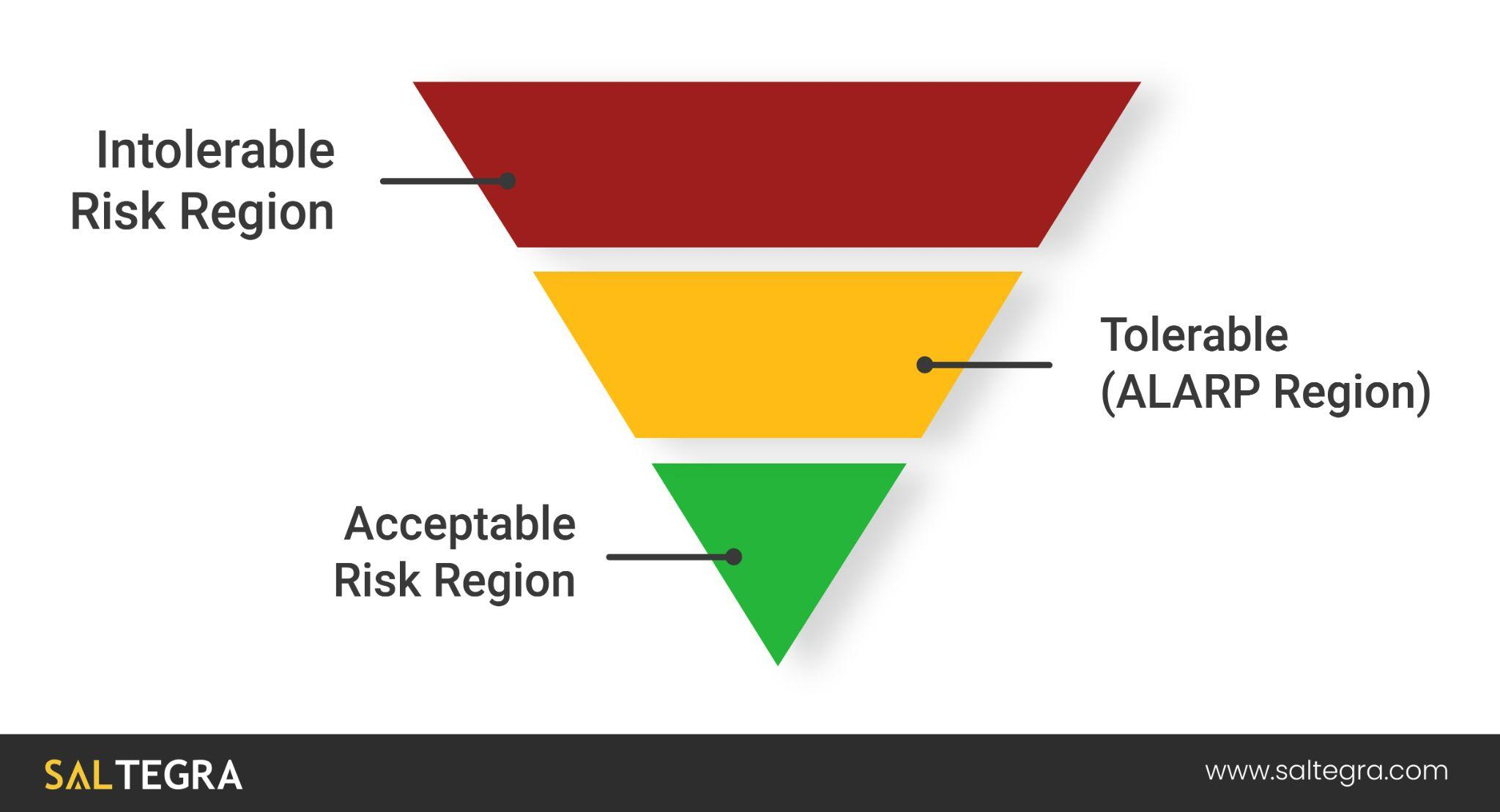
These quantitative results are then evaluated against predefined risk criteria to determine whether the risks fall within acceptable levels or require further mitigation.
Risk Mitigation and ALARP Demonstration
When risk levels exceed acceptable thresholds, Quantitative Risk Assessment supports the assessment of potential mitigation strategies through cost-benefit analysis. This step ensures alignment with the ALARP (As Low As Reasonably Practicable) principle, which emphasizes reducing risks to a level where further reduction would require resources that are significantly disproportionate to the safety benefits.
By quantifying both the costs and benefits of safety improvements, QRA offers a defensible basis for demonstrating that risk assessment and reduction efforts meet ALARP expectations. This evidence is often crucial for demonstrating compliance with regulatory agencies and establishing trust with stakeholders.
Sensitivity Analysis
Given that QRA relies on input data that may carry a degree of uncertainty, sensitivity analysis plays an essential role in evaluating how changes in key assumptions influence overall risk estimates.
This step helps identify the parameters that have the greatest impact on the outcome of the assessment. Understanding these drivers enables more focused data collection and model refinement. Conducting a well-structured sensitivity analysis strengthens the credibility of the QRA and supports more confident and informed decision-making.
Documentation and Reporting
Thorough documentation is essential to capture every stage of the QRA process, from initial assumptions and modeling approaches to final risk estimates and recommended actions.
The resulting technical report should be tailored to meet the needs of different audiences, including regulators, company leadership, plant personnel, and nearby communities. Well-prepared documentation not only fulfills regulatory requirements but also serves as a reference for future reviews and continuous improvement. As part of a broader safety management system, it supports transparency, accountability, and informed decision-making over time.
Why Does QRA Matter in High-Risk Industries?
Enhances Safety
QRA transforms safety management into a proactive effort by identifying and prioritizing risks before incidents occur. This enables organizations to focus on controls where they matter most. Safety investments are guided by actual risk, not recent incidents or external pressure, ensuring resources are focused on areas with the greatest potential impact.
Supports Decision Making
QRA informs critical decisions related to facility siting, process design, equipment selection, and operations. It provides a consistent framework for comparing options based on risk, thereby reducing subjectivity and grounding decisions in measurable data. It also provides a documented record of how safety influenced design and planning.
Compliance With Regulations
Many regulators now require quantitative safety evidence for high-risk operations. QRA demonstrates that hazards have been systematically assessed and managed within acceptable limits. Beyond compliance, it reflects an organization’s commitment to safety, operational integrity, and responsible corporate citizenship.
Conclusion
Quantitative Risk Assessment (QRA) is a critical approach for ensuring safety in high-risk industrial operations, replacing subjective assessments with data-driven analysis. As industrial systems become increasingly complex and public demand for accountability grows, the role of QRA becomes even more crucial.
It not only supports compliance with regulatory standards but also contributes to improved operational performance and long-term sustainability. Organizations can significantly benefit from developing internal QRA capabilities or collaborating with experienced consultants like Saltegra Consulting LLC, resulting in reduced incident risk, more efficient system designs, and increased confidence among stakeholders.
For assistance in navigating the Quantitative Risk Assessment (QRA) process, connect with our experts and let us guide in establishing a strong safety culture.