
Guide on How to Identify Your CalARP Program and How to Ensure Compliance
Introduction
The California Accidental Release Prevention (CalARP) Program is one of the most rigorous state-level safety regulations in the U.S. It’s designed to prevent the accidental release of hazardous substances that could impact workers, nearby communities, and the environment.
While rooted in the federal EPA Risk Management Program (RMP), CalARP incorporates additional safety layers unique to California’s risks—most notably, earthquake vulnerability and stronger process safety accountability. One of the first and most critical steps in complying with CalARP is determining your facility’s program level.
This article by Saltegra Consulting guides you through determining your CalARP program level using the California Accidental Release Prevention (CalARP) Program Guidance Document for the USA, real-world examples, and practical tips provided by experienced safety professionals.
Why Program Level Classification Is So Important
Each program level under CalARP dictates what you need to include in your Risk Management Plan (RMP) and how much documentation, hazard analysis, and prevention planning is required.
The classification:
- Determines if you need a simplified or comprehensive hazard review
- Dictates whether you must conduct a seismic assessment
- Decides if your facility will be subject to advanced requirements like Inherently Safer Systems (ISS), Human Factors Analysis, or third-party audits
Getting your classification wrong could result in a non-compliant RMP, regulatory violations, or even increased accident risk.
Step 1: Check Applicability – Are You Covered by CalARP?
CalARP covers a facility if it meets all the following:
- You handle a regulated substance (listed in CalARP Table 3),
- The amount of substance exceeds the threshold quantity, and
- The substance is used in a process that could result in offsite consequences during an accidental release.
If your facility meets these criteria, proceed to program level determination.
Step 2: Understand the Four CalARP Program Levels
CalARP uses a tiered system to match safety requirements to risk level. Each tier comes with distinct expectations. Here’s how each level breaks down.
Program 1: Low Risk, Minimum Requirements
Applies if:
- There have been no significant accidental releases in the last five years.
- A worst-case release would not affect public receptors.
- You’ve coordinated emergency response with local agencies.
Typical facilities:
- Water treatment plants with chlorine
- Small ammonia refrigeration units in remote areas
What’s required:
- Worst-case release analysis
- Emergency coordination
- Five-year accident history
Practical tip: If your facility is located in a populated or urban area, Program 1 likely won’t apply, even if you’ve had no incidents.
Program 2: Moderate Risk, Mid-Level Requirements
Applies if:
- Your facility doesn’t qualify for Program 1
- You’re not covered by OSHA PSM
- Your operations are moderately complex
Typical facilities:
- Smaller agricultural chemical storage sites
- Simple batch processes in industrial warehouses
What’s required:
- Hazard review (less rigorous than a full PHA)
- Written operating procedures
- Employee training and maintenance
- Incident investigation
- Emergency response program
- Seismic assessment (CalARP only)
- Compliance audits every 3 years
Practical tip: Don’t underestimate the seismic assessment—it’s state-mandated for Program 2 and above and must be signed by a qualified engineer.
Program 3: Complex Operations, Higher Risk
Applies if:
Your facility is subject to OSHA Process Safety Management (PSM), OR
You operate in high-risk NAICS codes (chemical manufacturing, refineries, pharmaceuticals)
Typical facilities:
- Refineries and tank farms
- API-certified chemical facilities
- Pharma or high-volume processing plants
What’s required:
- Full Process Hazard Analysis (e.g., HAZOP)
- Management of Change (MOC)
- Mechanical integrity program
- Pre-startup safety review
- Seismic assessment
- Emergency planning and public engagement
- Detailed RMP submittal and CUPA review
Practical tip: Work closely with your CUPA. Unannounced audits are common, and public involvement steps must be clearly documented and communicated.
Program 4: Refineries Under Maximum Oversight
Applies if:
- You are a petroleum refinery in California
Typical facilities:
- Oil refineries
What’s required:
- Everything in Program 3, plus:
- Inherently Safer Systems (ISS) analysis
- Human Factors Analysis (operator fatigue, control room design, alarm layout)
- Damage Mechanism Review (DMR)
- Use of the Hierarchy of Controls
- Third-party safety audits
Practical tip: Program 4 is the most stringent—be ready to justify why you didn’t implement inherently safer design options.
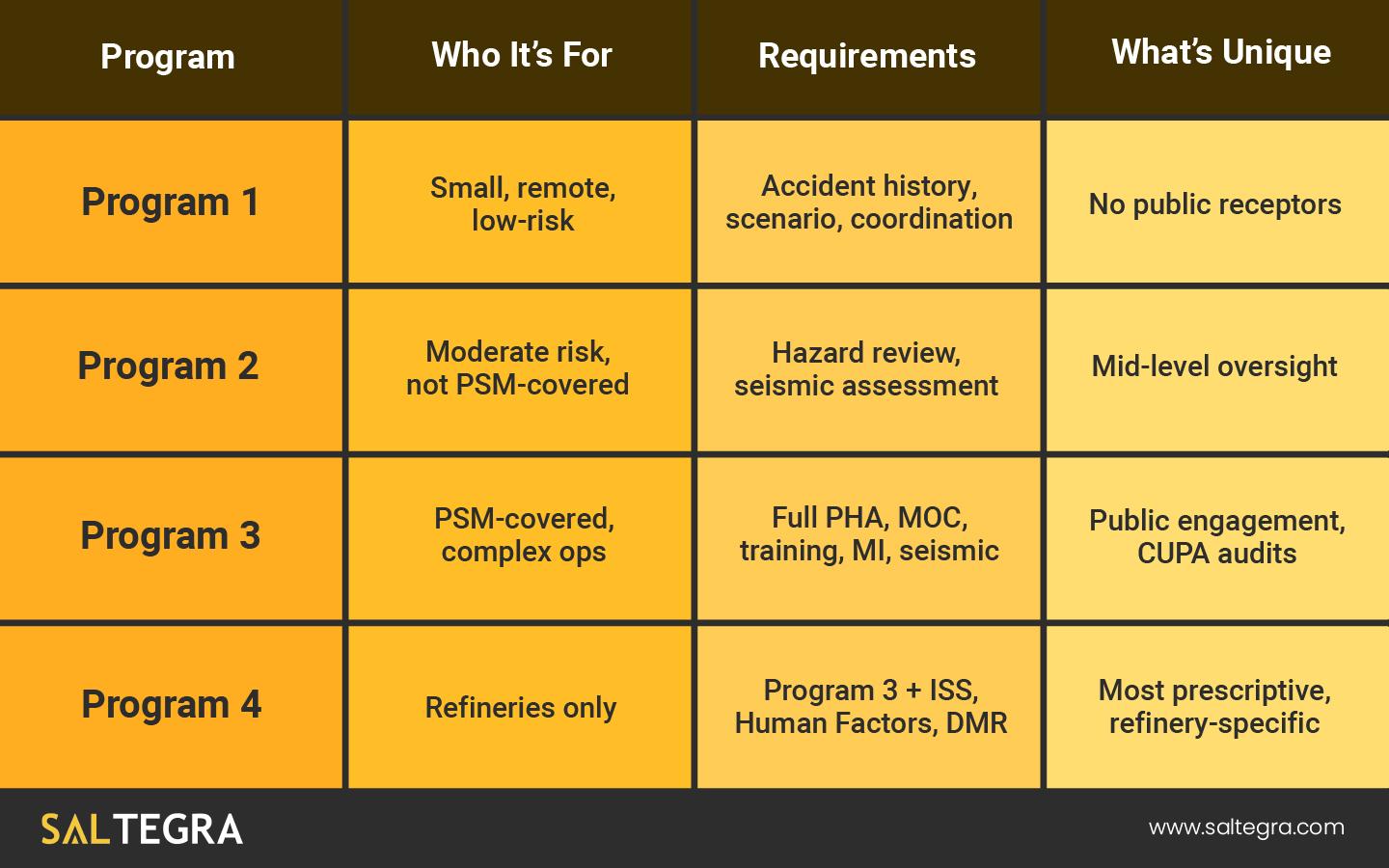
Quick Reference Table – CalARP Program Levels
 Step 3: Use the CalARP Guidance Document as Your Manual
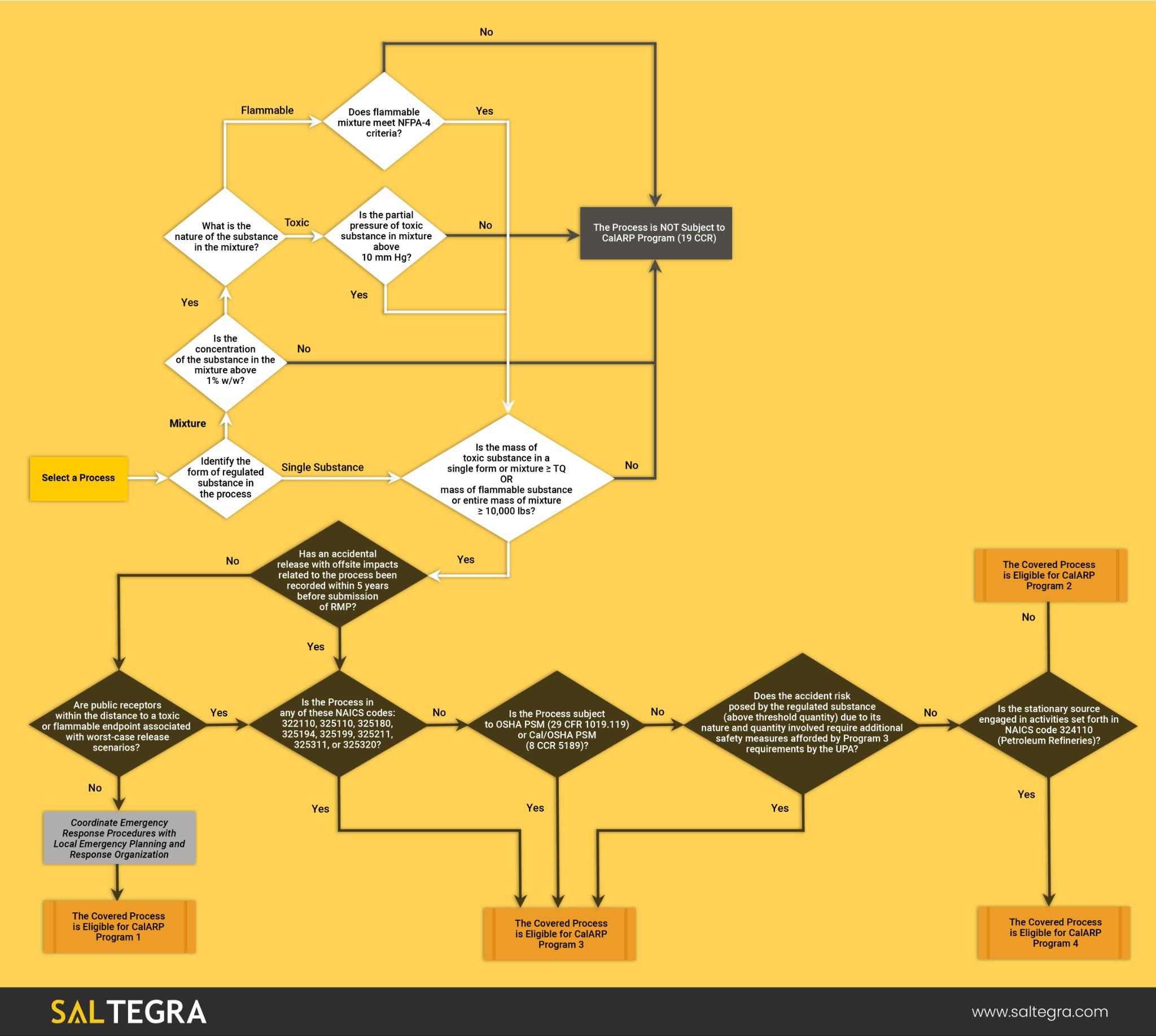
The California Accidental Release Prevention (CalARP) Program Guidance Document USA, published by Cal OES, contains all the technical definitions, eligibility criteria, and submittal expectations. Facilities use this document to:
- Confirm program level with flowcharts
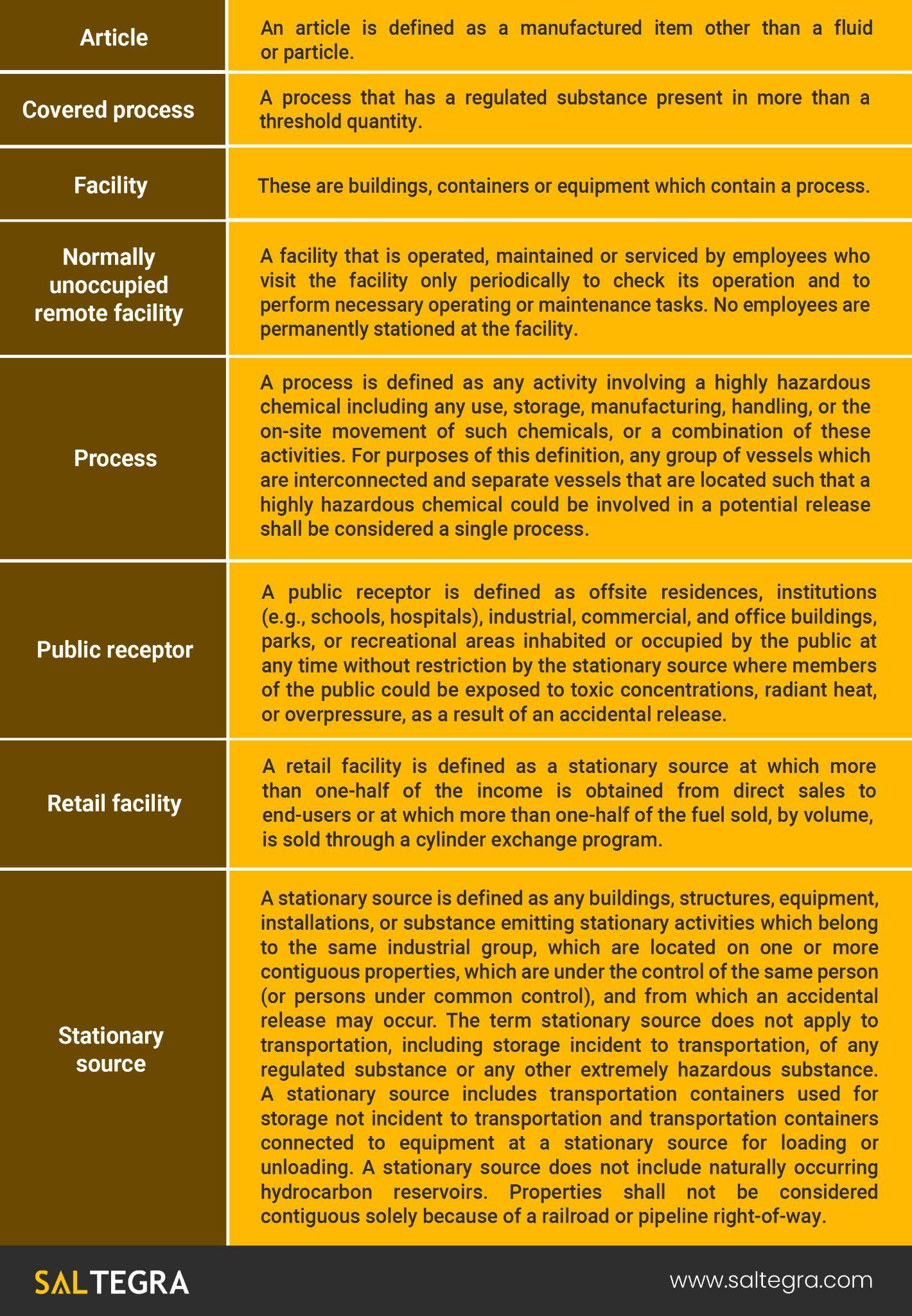
- Understand terminology. The most commonly used terminologies for program-level determination are as follows.
- Prepare submittals in CERS (California Environmental Reporting System)
- Meet CUPA documentation expectations
Practical tip: The guidance document includes examples of compliant RMPs, audit checklists, and FAQs. Download the most recent version from Cal OES website.
Step 4: Confirm with Your CUPA Early
CUPAs (Certified Unified Program Agencies) are your local regulatory authority for CalARP. They review your RMP and may request changes or clarifications—especially on:
- Offsite consequence modeling
- Seismic calculations
- Safeguard descriptions
- Emergency response plan effectiveness
Many CUPAs offer pre-submission technical consultations. Taking advantage of this can reduce errors and prevent rejections.
Step 5: Ensure Ongoing Compliance After Submittal
Your RMP isn’t “one and done.” Updates are required:
- Every 5 years
- When a new process or chemical is added
- After a major accident or near miss
- If regulations or CUPA expectations change
Facilities in Programs 3 and 4 should also keep up with:
- Annual audits or third-party reviews
- Employee training refreshers
- ISS documentation updates
- PHA revalidations
Conclusion
Identifying your CalARP program level is more than just a classification—it shapes the entire structure of your safety program. From minimal documentation under Program 1 to the deep-dive analysis required in Program 4, understanding your obligations is essential for staying compliant and protecting your facility.
Whether you’re managing a simple bulk chemical storage unit in the USA or operating a refinery, the combination of California Accidental Release Prevention (CalARP) guidance, CUPA oversight, and best-practice implementation ensures that you’re not just checking boxes—but building a safer process.
Saltegra Consulting provides comprehensive CalARP support, including RMP development, PHAs, seismic assessments, and ISS analysis, tailored to your facility’s program level. Let us help you turn regulatory compliance into operational resilience. Contact our team today!