

A Guide on How to Ensure Compliance When Submitting Your CalARP RMP
Introduction
Accidental chemical releases pose serious risks to people, property, and the environment. In California, facilities storing or handling regulated substances in quantities exceeding the threshold must develop a California Accidental Release Prevention (CalARP) Risk Management Plan (RMP). While based on the federal EPA Risk Management Program (RMP), CalARP introduces additional layers of requirements, oversight, and public accountability that go beyond the federal baseline.
Understanding how the CalARP RMP differs from and overlaps with the EPA RMP is crucial for ensuring compliance. In this article, Saltegra Consulting will present an overview of these programs, outline the differences by program level, and guides how to align your facility’s risk management planning efforts accordingly.
Here’s a high-level comparison:
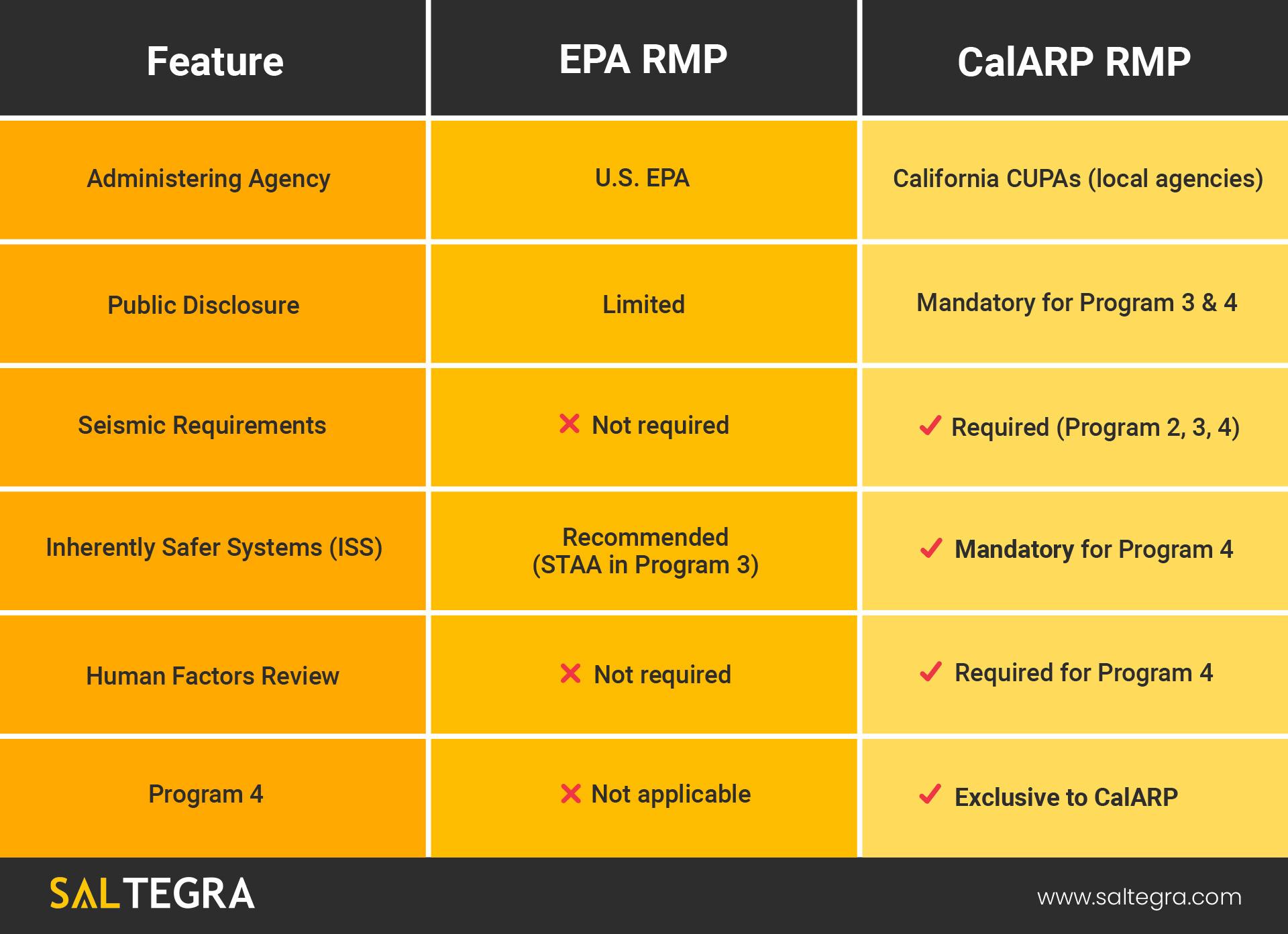
CalARP RMP vs. EPA RMP: Key Considerations
Both California Accidental Release Prevention (CalARP) and EPA Risk Management Plan (RMP) are designed to prevent the accidental release of hazardous chemicals through a structured system of hazard analysis, emergency response, and management systems. However, CalARP is administered at the state level by California’s Certified Unified Program Agencies (CUPAs) and features several enhancements not found in the EPA’s program.
For example, CalARP places a greater emphasis on community right-to-know, seismic safety, and inherently safer design. In particular, CalARP’s Program 4—exclusive to California—targets petroleum refineries and requires rigorous safety practices, including human factors analysis, damage mechanism review (DMR), and third-party audits.
Whereas the EPA RMP focuses more on documenting and evaluating the risks of accidental releases, CalARP is more proactive in addressing and reducing those risks through preventive measures. This divergence creates significant implications for facilities required to comply with both regulations.
CalARP’s Four Program Levels
The CalARP regulation categorizes facilities into four distinct program levels based on the potential severity and complexity of the chemical processes involved. Each level builds on the previous one, with additional requirements for risk mitigation, documentation, and stakeholder engagement.
- Program 1 applies to facilities with simple processes and minimal offsite impact.
- Program 2 targets moderate-risk processes that are not subject to OSHA PSM standards.
- Program 3 aligns closely with OSHA PSM and EPA RMP Program 3, focusing on complex, high-risk facilities.
- Program 4, a CalARP-exclusive tier, applies specifically to petroleum refineries and introduces stringent state-specific safety practices.
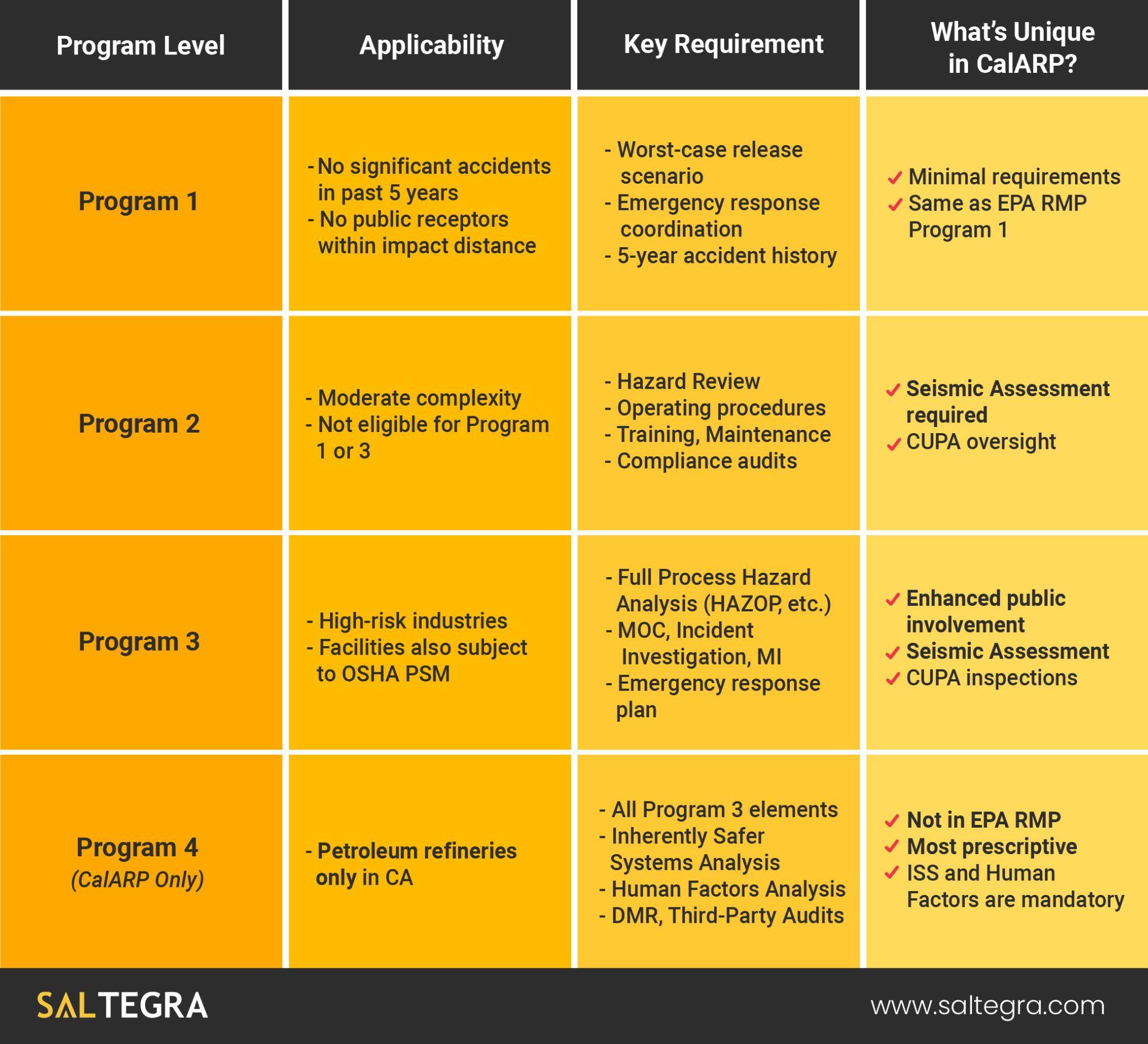
Let’s take a closer look at what each program level entails and how they differ from their EPA counterparts.
Program 1: Low Risk, Minimal Requirements
Program 1 represents the least burdensome tier under both EPA and CalARP RMPs. It applies to facilities that have not experienced any significant accidental releases in the past five years and are located such that no public receptors could be affected by a worst-case release.
Under both programs, the requirements include:
- A five-year accident history
- A worst-case release scenario analysis
- Coordination with local emergency responders
There are no additional safety reviews, hazard assessments, or internal procedures mandated at this level. Importantly, CalARP makes no modifications to Program 1, meaning that facilities compliant with EPA’s Program 1 are automatically compliant with CalARP’s version as well.
Program 2: Moderate Complexity, State-Specific Additions
Program 2 covers facilities that do not qualify for Program 1 but are not as complex as those in Program 3. This tier requires facilities to implement several process safety elements, including:
- A hazard review
- Standard operating procedures (SOPs)
- Preventive maintenance and training programs
- Compliance audits every three years
Where CalARP diverges from the EPA is in its requirement for a Seismic Assessment, which ensures that equipment and infrastructure can withstand earthquake forces. This requirement is particularly significant in California due to the state’s seismic activity and is not addressed in the federal RMP.
CalARP also mandates stronger oversight from CUPAs, which have the authority to review and enforce compliance directly at the local level. This can lead to more frequent inspections and tighter scrutiny compared to the EPA’s more generalized oversight structure.
Program 3: High Risk and Broad Regulatory Alignment
Program 3 is where the requirements under CalARP and the EPA RMP begin to resemble each other—at least on paper. This level applies to facilities in certain high-hazard industries (e.g., chemical manufacturing, petroleum refining) or those subject to OSHA’s Process Safety Management (PSM) standard.
Both EPA and CalARP require:
- A formal Process Hazard Analysis (PHA) such as HAZOP
- Management of Change (MOC) procedures
- Pre-startup safety reviews (PSSR)
- Mechanical integrity programs
- Emergency response plans
- Incident investigation procedures
- Training and employee participation programs
However, CalARP expands these requirements by enforcing:
- Seismic hazard reviews
- Enhanced public communication provisions
- CUPA’s authority to conduct unannounced inspections
These additions reflect California’s commitment to transparency and proactive prevention, elevating the regulatory burden and necessitating stronger internal coordination and documentation for compliance.
Program 4: A California-Only Tier for Refineries
Program 4 is where CalARP fully separates from the EPA framework. This tier applies only to petroleum refineries in California and reflects the most advanced level of process safety requirements in the state.
In addition to all Program 3 elements, Program 4 facilities must implement:
- Inherently Safer Systems (ISS) Analysis, which requires identification and application of safer alternatives where feasible
- Human Factors Analysis, addressing control room design, fatigue, and interface usability
- Damage Mechanism Reviews (DMRs) to detect corrosion, cracking, and other failure modes in equipment
- Third-party audits are conducted by independent and qualified firms
- Use of the Hierarchy of Controls, favoring elimination and substitution of hazards over administrative or PPE-based measures
These elements are not merely best practices—they are mandated components of the risk management process in Program 4. Refineries must not only document their compliance but demonstrate that inherently safer design options were actively considered and implemented where possible.
Program-Level Comparison with EPA RMP
When comparing the CalARP and EPA RMP frameworks by program level, it becomes clear that while Programs 1 and 3 share substantial overlap, Programs 2 and especially 4 diverge in important ways. Facilities in California must therefore adopt a dual-compliance approach, ensuring they meet both federal standards and the state’s more detailed expectations, particularly in seismic safety, stakeholder engagement, and the use of inherently safer technologies.
The table below compares each program level across both frameworks, highlighting regulatory overlaps and key differences.
Conclusion
Successfully submitting a California Accidental Release Prevention (CalARP) Risk Management Plan involves more than meeting federal EPA RMP standards. CalARP is layered with additional requirements, particularly under Programs 2 through 4, that reflect California’s risk profile, environmental policies, and safety priorities.
From seismic vulnerability assessments to human factors reviews, facilities must be prepared to document, review, and justify every safety element included in their strategic planning and risk management plans. A strategic, proactive approach to compliance—supported by proper planning, resource allocation, and expert consultation—will go a long way in ensuring operational safety and regulatory approval.
Saltegra Consulting is here to support facilities through every step of the CalARP RMP process. Our team of experts provides facilitation, documentation, and program development services tailored to both state and federal requirements, helping clients ensure safety, stay compliant, and mitigate risks.