An Introduction to Safety Instrumented Systems (SIS) Functional Safety and Why You Need It
Introduction
In complex industrial environments, where hazardous materials are processed under high temperatures and pressures, a single fault or oversight can lead to catastrophic consequences. Whether it’s a release of toxic gas, a runaway chemical reaction, or an equipment failure causing fire or explosion, the stakes are high. This is where functional safety becomes essential.
Functional safety is the part of overall safety that depends on a system or equipment functioning correctly in response to its inputs. Specifically, it ensures that automatic safety functions—such as emergency shutdowns, overpressure protection, or fire detection systems—act precisely when needed to prevent accidents or reduce their impact. Unlike passive safety measures (e.g., fireproofing or barriers), functional safety is a dynamic concept. It detects abnormal situations and initiates an active response, reducing risk to a tolerable level.
In industries like oil and gas, petrochemicals, pharmaceuticals, and power generation, functional safety is a cornerstone of responsible operations. It ensures that technology not only enables productivity but also defends against harm.
The Standards That Guide Functional Safety
To ensure consistency and reliability, international standards govern functional safety practices, outlining how safety systems should be designed, verified, operated, and maintained. The most widely referenced of these are IEC 61508 and IEC 61511.
IEC 61508 is the foundational standard for functional safety. It applies to electrical, electronic, and programmable electronic (E/E/PE) safety-related systems across all industries. The standard introduces the concept of the safety lifecycle, guiding the identification, implementation, and review of safety functions over time. It provides a framework for determining the reliability required of a safety function, based on the severity and likelihood of the hazards it protects against.
Building on this foundation, Safety Instrumented Systems (SIS) (IEC 61511/ISA 84) adapt the IEC 61508 principles specifically for the process industries. It addresses the use of Safety Instrumented Systems (SIS) in continuous and batch processing environments, such as refineries, chemical plants, and water treatment facilities. IEC 61511 is especially important because it not only covers design and implementation but also places significant emphasis on operation, maintenance, testing, and management of change, where many real-world failures occur.
What Is a Safety Instrumented System (SIS)?
Imagine a high-pressure gas vessel in a refinery. If the pressure begins to rise beyond safe limits, there must be a way to detect this and quickly shut off the feed or release pressure before the vessel ruptures. This is the job of a Safety Instrumented System (SIS).
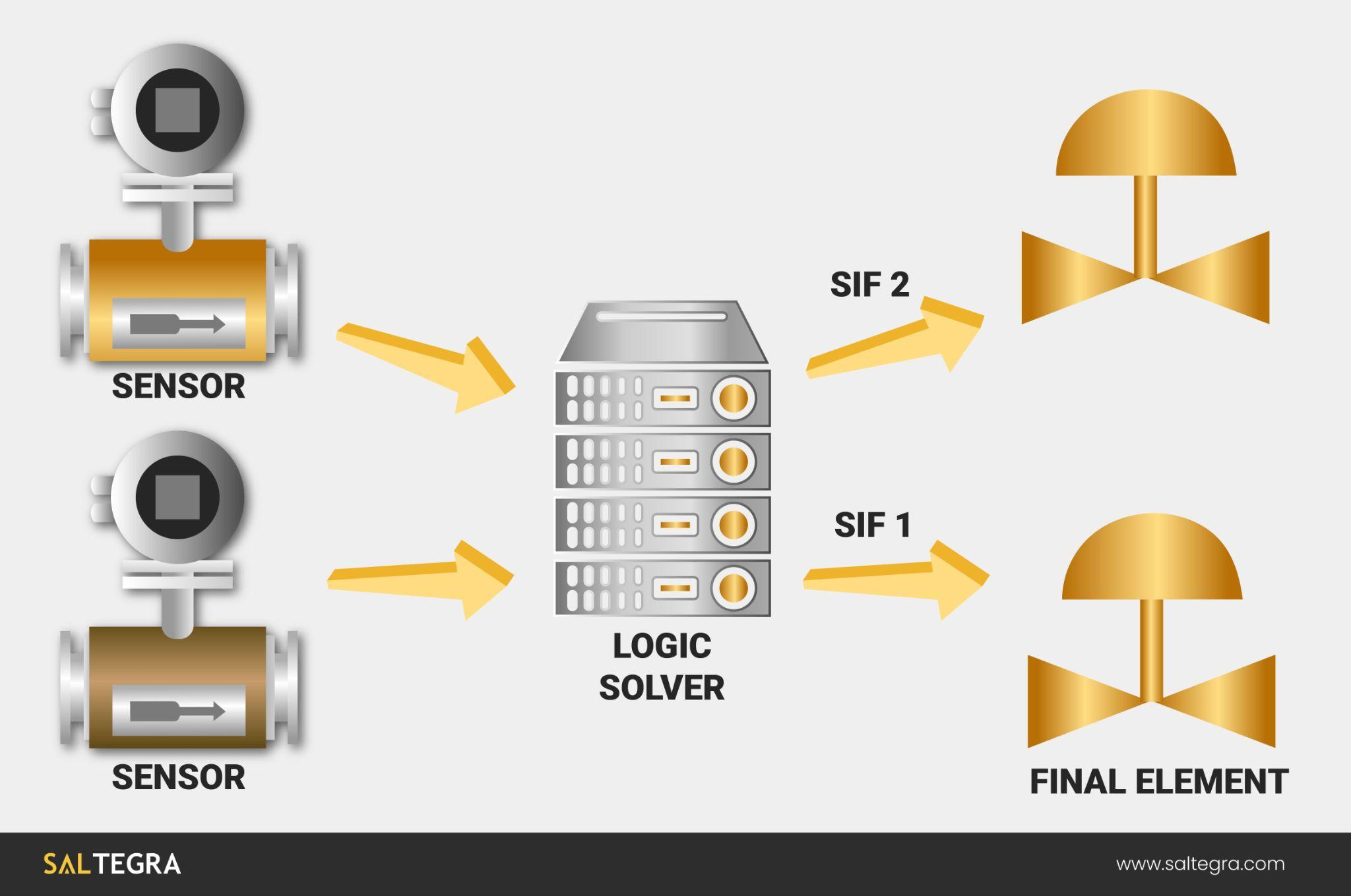
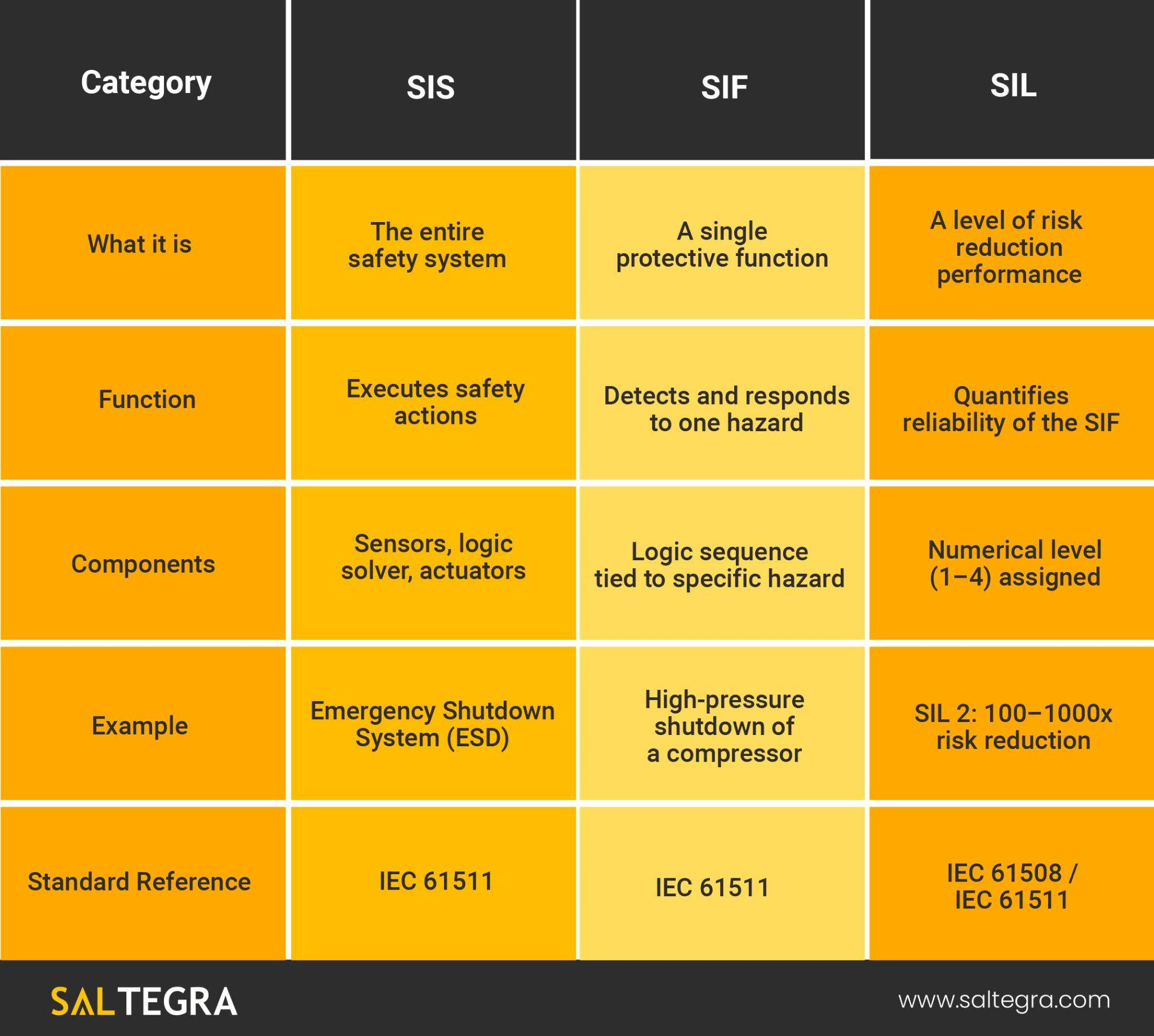
A Safety Instrumented System (SIS) is a dedicated system designed to perform one or more safety instrumented functions (SIFs). It is separate from the basic process control system (BPCS), ensuring it can operate independently even if the BPCS fails.
A typical SIS consists of three key components:
- Sensors continuously monitor the process for hazardous conditions, such as high pressure, high temperature, or the presence of toxic gases.
- A logic solver, which receives signals from the sensors and decides, based on pre-programmed logic, whether a safety action is needed.
- Final control elements, such as emergency shutdown valves or breakers, act to bring the process to a safe state.
The purpose of the SIS is simple: to detect abnormal conditions early and take swift, automatic action to prevent escalation.
Safety Instrumented Functions: The Building Blocks of SIS
Each specific protective action taken by an SIS is referred to as a Safety Instrumented Function (SIF). A SIF has a clear objective: to reduce the risk associated with a particular hazard to an acceptable level.
For example:
- A high-pressure SIF might close a valve to prevent a pressure vessel from exploding.
- A gas detection SIF might shut down equipment and isolate a section of a plant upon detecting a flammable leak.
- A high-temperature SIF might trip a reactor’s feed pump if the temperature exceeds safe operating limits.
Every SIF is tied to a hazard scenario and is engineered based on the level of risk it needs to mitigate. The required level of performance for a SIF is expressed as a Safety Integrity Level (SIL).
The Role of Safety Integrity Level (SIL) in Functional Safety
Safety Integrity Level (SIL) is a critical concept in functional safety. It represents how reliably a SIF must perform its function when called upon. There are four SIL levels, with SIL 1 being the lowest and SIL 4 the highest. As the required SIL increases, the allowable probability of failure decreases, and the complexity, cost, and rigor of engineering increase.
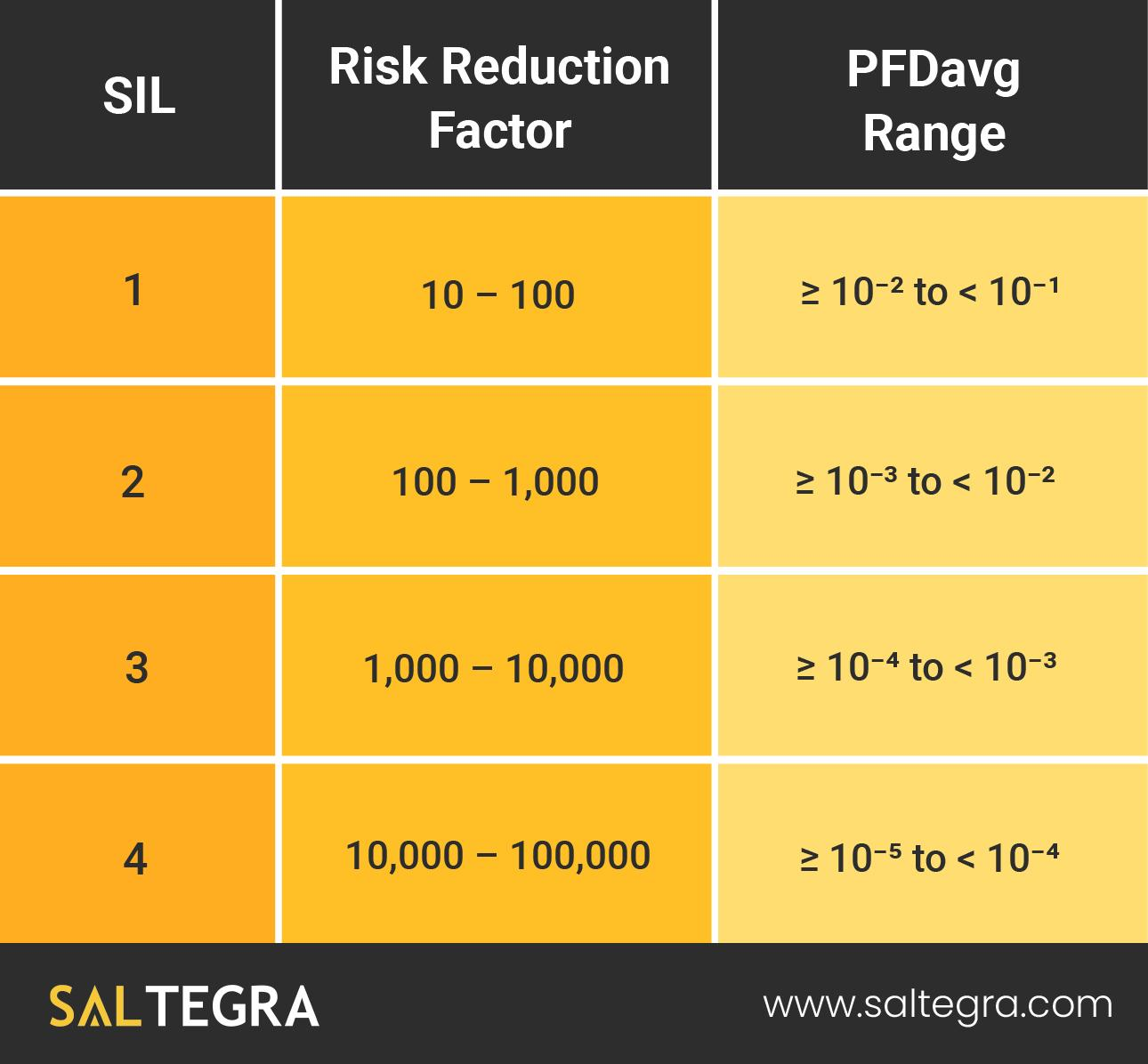
Determining and verifying the right SIL starts with hazard identification and risk assessment. Techniques like HAZOP (Hazard and Operability Study) are used to uncover potential deviations in process conditions. Then, LOPA (Layer of Protection Analysis) evaluates how likely the hazard is and what protections are already in place. If the risk is too high, a SIF is added and assigned the SIL required to bring the risk down to an acceptable level.
Once a SIL is assigned, the next challenge is Verification—ensuring the SIF, as designed, will perform as required. This involves modeling hardware reliability, performing Probability of Failure on Demand (PFD) calculations, and checking that the system architecture meets redundancy and diagnostic coverage requirements.
The Functional Safety Lifecycle
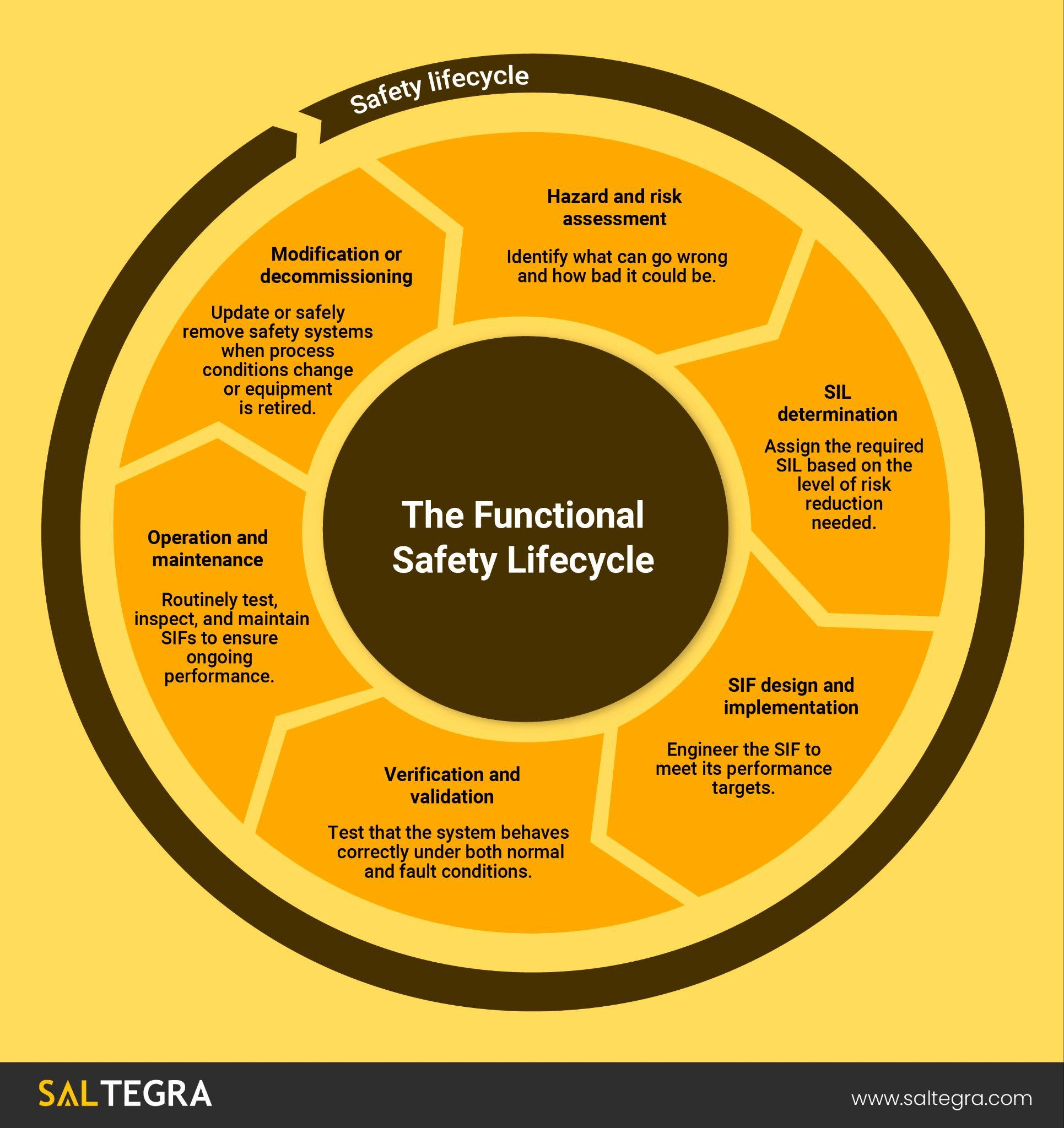
Functional safety is not a one-time engineering task—it’s a process that spans the entire life of the system. The functional safety lifecycle, defined in IEC 61508 and IEC 61511, ensures that safety is considered from the earliest design phase through to decommissioning.
The Lifecycle Stages:
- Hazard and risk assessment – Identify what can go wrong and how bad it could be.
- SIL determination – Assign the required SIL based on the level of risk reduction needed.
- SIF design and implementation – Engineer the SIF to meet its performance targets.
- Verification and validation – Test that the system behaves correctly under both normal and fault conditions.
- Operation and maintenance – Routinely test, inspect, and maintain SIFs to ensure ongoing performance.
- Modification or decommissioning – Update or safely remove safety systems when process conditions change or equipment is retired.
Each stage includes rigorous documentation, peer review, and risk-based decision-making. Following this lifecycle ensures that safety systems evolve with the plant and remain effective throughout their lifespan.
Functional Safety Assessment (FSA): Ensuring It All Works
Even the best-designed safety system needs independent evaluation from time to time. That’s where Functional Safety Assessments (FSAs) come in. An FSA is a structured review of how well the safety lifecycle has been followed and whether the Safety Instrumented Systems (SIS) and SIFs meet their safety objectives.
IEC 61511 outlines five levels of FSA, each corresponding to a specific stage of the lifecycle: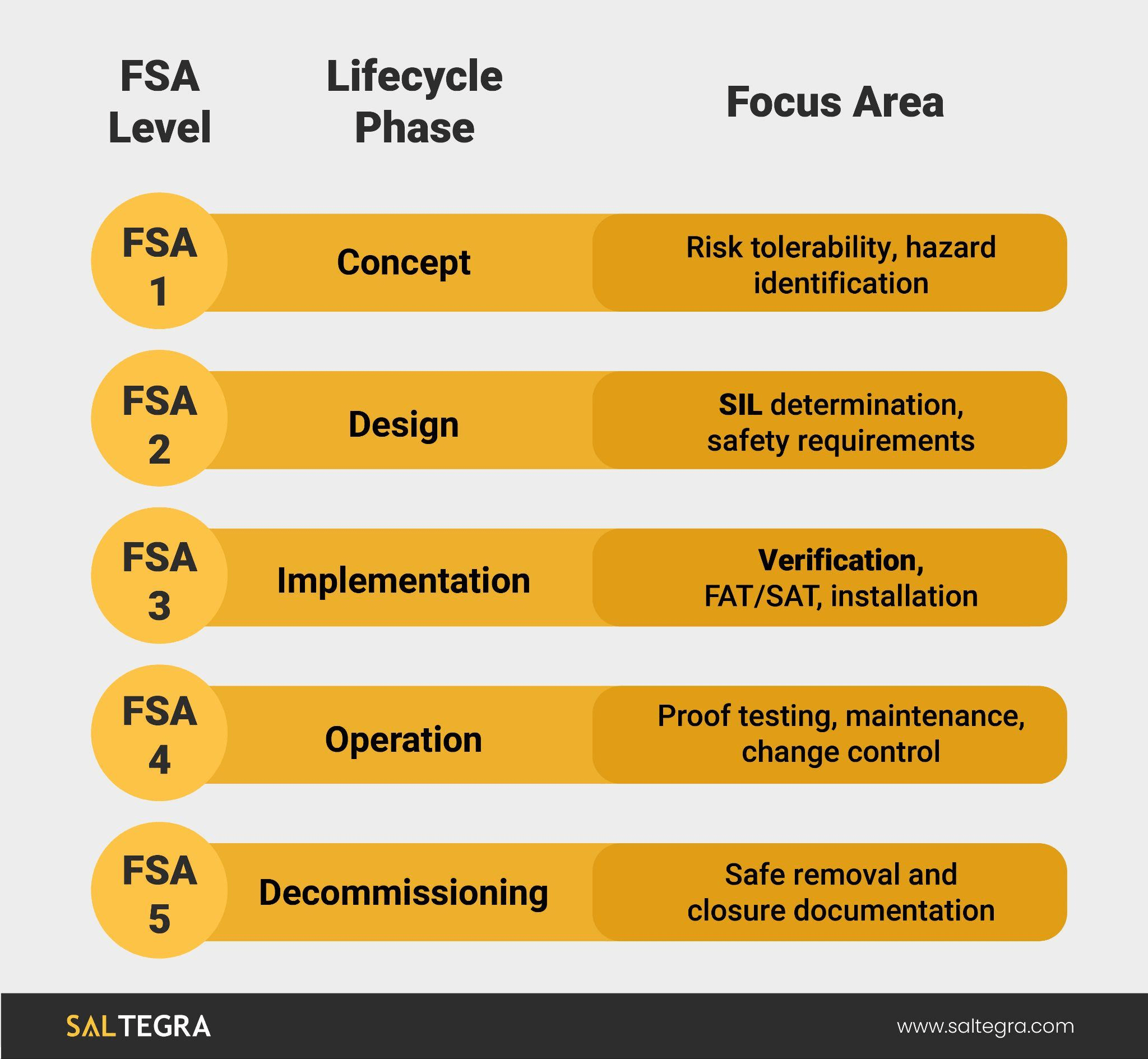
FSA activities include document reviews, interviews, and site walkthroughs. The outcome is a formal report that highlights compliance, identifies gaps, and recommends improvements.
The Role of Consultants and Independent Experts
Many companies rely on functional safety consultants to guide them through the lifecycle or perform independent FSAs. These experts bring knowledge of standards, best practices, and real-world failures, ensuring that Safety Instrumented Systems (SIS) are not only compliant but also practical and maintainable.
Consultants may assist with:
- SIL determination and LOPA facilitation
- SIS and SIF design reviews
- FSA readiness assessments
- Full lifecycle planning and implementation
- Internal training and procedure development
Their support enhances credibility, ensures compliance, and helps build confidence in the systems protecting people and assets.
Conclusion: Why Functional Safety Matters
Functional safety is more than an engineering obligation—it is a proactive strategy for managing risk. Ensuring that automated protection systems perform reliably in the face of abnormal conditions, it protects lives, equipment, and the environment.
Following the frameworks of IEC 61508 and Safety Instrumented Systems (SIS) (IEC 61511 / ISA 84), applying proper lifecycle management, and performing ongoing Verification ensures that safety is not left to chance. At the core of this effort are robust, well-designed Safety Instrumented Systems (SIS) and appropriately assigned Safety Integrity Level (SIL) targets.
With these tools and the help of experts like Saltegra Consulting, functional safety becomes a powerful approach to creating safer and more resilient operations. Contact our team today and let us introduce you to our tailored safety solutions.