

5 Dispersion Models and How to Use Them in Industrial Hazard Assessment

Introduction
In industrial operations that involve hazardous chemicals, understanding how a substance disperses in the environment after an accidental release is essential. Dispersion modelling is the process used to simulate the movement of gases or vapors once they are released into the atmosphere. It is a foundational tool for assessing potential off-site impacts, supporting emergency planning, and meeting regulatory obligations under programs such as the EPA’s Risk Management Program (RMP) and the California Accidental Release Prevention (CalARP) Program.
This article introduces the five primary types of dispersion models used in industrial hazard assessments, highlights their key differences, and discusses their application in maintaining safety and compliance.
How Does Dispersion Modeling Work?
At its core, dispersion modelling involves mathematical equations to estimate how pollutants move and dilute in the air after a release. Models take into account several variables, such as:
- The physical and chemical properties of the released substance
- Meteorological conditions, including wind speed, temperature, and atmospheric stability
- Terrain features like elevation and surface roughness
- Source characteristics such as release height, duration, and flow rate
The model then predicts the concentration of the hazardous substance over a specified area and timeframe. This information is critical in determining exposure zones, evaluating public health risks, and designing effective mitigation strategies.
Types of Dispersion Models
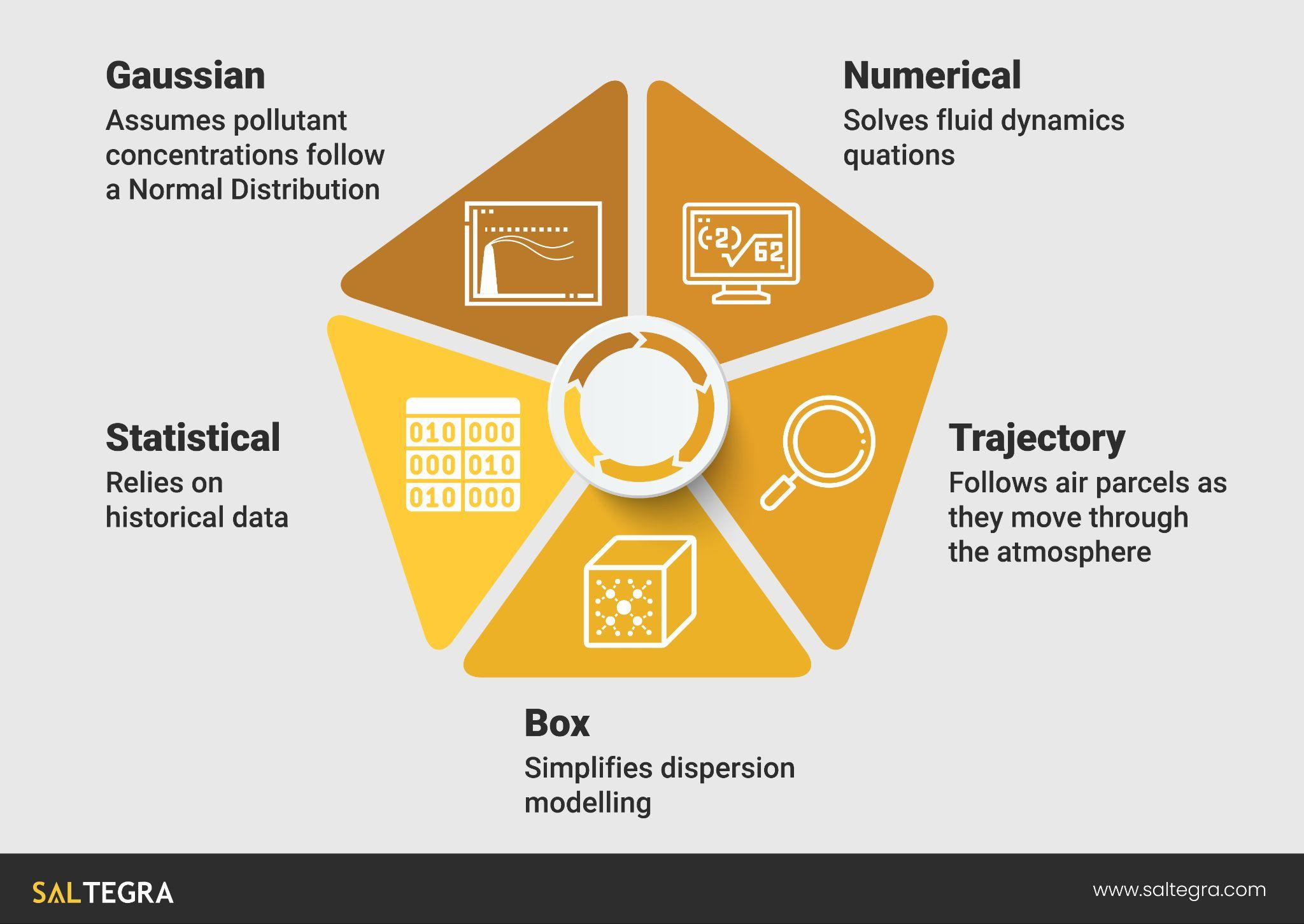
Gaussian Model
The Gaussian dispersion model is one of the oldest and most widely used. It assumes that pollutant concentrations follow a Normal Distribution, both horizontally and vertically, forming a bell-shaped curve.
Best suited for: Steady-state releases under uniform meteorological conditions over flat terrain
Limitations: Less accurate in complex terrain, variable weather conditions, or for heavy gases
Common applications: Regulatory air permitting, estimating public exposure zones, emergency response planning
Models such as AERMOD and SCREEN3 are examples of tools based on the Gaussian approach. These models are often used to satisfy environmental regulatory requirements because they provide quick and conservative estimates.
Numerical Model
Numerical models, including Computational Fluid Dynamics (CFD), solve fluid dynamics equations to simulate pollutant dispersion in detail. They account for wind turbulence, buildings, obstructions, and temperature gradients.
Best suited for: High-resolution modeling in complex environments such as congested process areas
Limitations: Resource-intensive and requires expert knowledge to operate and interpret
Common applications: Leak assessments near buildings, confined spaces, and tank farms
These models are ideal for analyzing site-specific risks where precision is important for decision-making, especially in high-consequence scenarios.
Trajectory Model
A trajectory model follows air parcels as they move through the atmosphere, using real or forecasted meteorological data to determine the likely path of a release.
Best suited for: Long-range transport of pollutants over time and changing weather conditions
Limitations: Lower spatial accuracy, not ideal for near-field or dense gas applications
Common applications: Regional impact assessments, transport of plumes across jurisdictions, event reconstruction
The HYSPLIT model, developed by NOAA, is a widely used example. This model is often used for emergency planning in large-scale chemical or radiological incidents.
Box Model
The box model simplifies dispersion by treating the atmosphere as a uniform, well-mixed volume. It estimates the average concentration of a pollutant within this volume over time.
Best suited for: Initial screening assessments, indoor environments, or estimating long-term averages
Limitations: Oversimplified and does not consider spatial variation
Common applications: Preliminary risk assessments, indoor air quality evaluations
Box models are fast and easy to implement, though they are usually followed by more detailed assessments for regulatory or engineering purposes.
Statistical Model
Statistical models rely on historical data or probabilistic approaches to estimate dispersion. They can incorporate uncertainty and variability in release conditions or weather patterns.
Best suited for: Probabilistic risk assessment, long-term planning, or when empirical data is available
Limitations: Less detail on spatial dispersion, and not suitable for real-time emergency response
Common applications: Scenario-based assessments, cumulative impact evaluations, insurance, or liability modeling
These models are typically used to inform broader decision-making processes rather than acute incident response.
Why Is Dispersion Modeling Important?
Dispersion modelling provides essential insights into how a hazardous substance might spread, who or what may be affected, and how much time responders or the public may have to react. It serves several critical functions:
- Public Safety: Dispersion models define the geographic areas that may be exposed to harmful concentrations. This enables emergency planners to develop evacuation routes, shelter-in-place protocols, and public notification procedures.
- Environmental Protection: Chemical releases can impact air quality, ecosystems, and water sources. Accurate modeling helps facilities evaluate their ecological footprint and implement strategies to minimize long-term damage.
- Regulatory Compliance: Government regulations often mandate the use of approved dispersion models as part of permit applications or risk management plans. Agencies such as the EPA, CalEPA, and OSHA require defensible and validated modeling to assess potential impacts of accidental releases.
- Operational Decision-Making: Dispersion modelling supports engineering decisions related to stack heights, vent placements, and containment strategies. It also guides investment in mitigation technologies and emergency preparedness measures.
Conclusion
Dispersion modelling is an essential tool for industrial facilities handling hazardous materials. Each model, whether it is Gaussian, numerical, trajectory-based, statistical, or a simple box model, offers unique strengths tailored to different risk scenarios.
Choosing the right model depends on the purpose of the assessment, the level of accuracy needed, and the complexity of the environment. Whether used for compliance, risk reduction, or emergency response, dispersion models help organizations act responsibly and protect what matters most—people, the environment, and operational integrity.
Working with qualified process safety experts can make all the difference for facilities seeking to improve their hazard assessment capabilities or navigate regulatory requirements with confidence. Effective dispersion modelling starts with the proper guidance, sound methodology, and a clear understanding of the risks involved.
Partner with experts at Saltegra Consulting today to strengthen your hazard assessment with tailored safety solutions and apply precision-driven dispersion modelling.