Chemical Handling Safety Guide Steps in Assessing Chemical Hazards in the Workplace
Introduction
Chemical hazards can pose significant risks to health and safety, including irritation, sensitization, cancer, and physical threats like fires, corrosion, and explosions. Without proper assessment and control, these dangers can result in serious workplace incidents. A chemical hazard assessment for process safety in the USA offers a structured way to identify and evaluate these risks, considering a substance’s properties and the potential for exposure.
This guide outlines key steps to assess chemical hazards, implement adequate safety measures, and maintain compliance with standards such as OSHA’s Process Safety Management (PSM) and the EPA’s Risk Management Plan (RMP).
Basic Steps in Hazard Assessment for Chemical Operations
The chemical hazard assessment process for safety in the USA follows a structured methodology that can be broken down into several key steps:
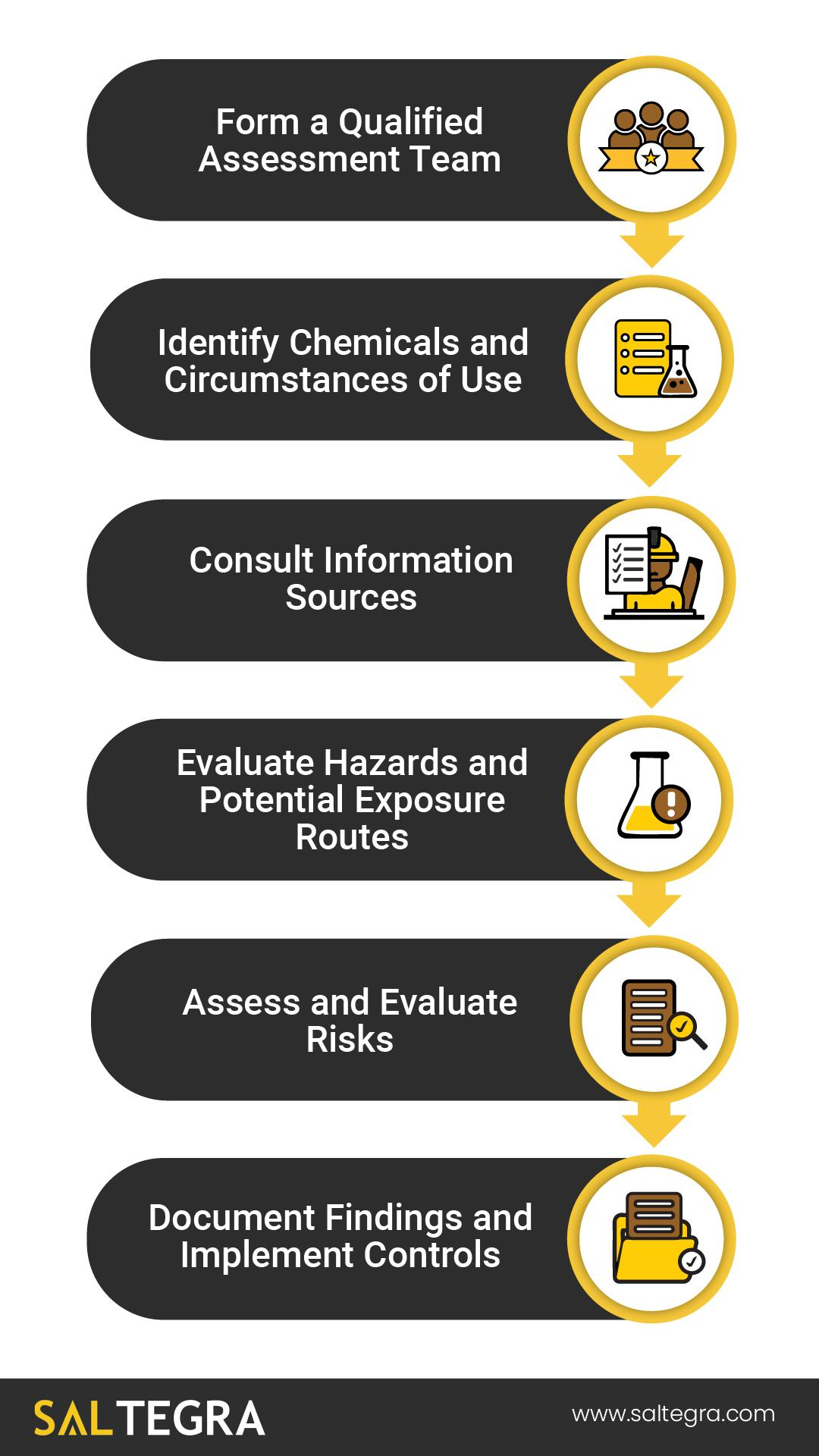
Form a Qualified Assessment Team
Begin by forming a team with the appropriate mix of technical knowledge and hands-on experience. Team members should understand Workplace Health and Safety (WHS) requirements, be able to interpret Safety Data Sheets (SDS), and have practical familiarity with site operations and the chemicals involved. They should also have time to conduct site inspections and support documentation efforts.
Identify Chemicals and Circumstances of Use
Create a detailed inventory of all chemicals on-site. Record product names, storage locations, container types, usage areas, hazard identification of chemicals, flammability, health risks, and how each chemical is used in operations.
Consult Information Sources
Review current Safety Data Sheets (SDS) for each chemical and consult supervisors or safety experts for unfamiliar substances or high-risk tasks. These sources offer essential details on hazards, exposure limits, and control measures.
Evaluate hazards and Potential Exposure Routes
Assess the potential incidents each chemical may cause based on toxicity and mode of entry. Identify whether substances could be inhaled, absorbed through skin, ingested, or become airborne as dusts or aerosols during use.
Assess and Evaluate Risks
Evaluate the risks arising from identified hazards, considering whether existing safety measures are adequate or if additional controls are needed. This assessment should account for how chemicals are used, who might be exposed, and under what conditions.
Document Findings and Implement Controls
Record assessment findings and establish appropriate safety measures to eliminate or reduce the hazards associated with chemical operations. Review the assessment regularly and revise when processes change or new information becomes available.
A Detailed Guide in Assessing Risks and Implementing Safety Controls
Identifying the Chemical Hazards and Risks
Before any chemical task, conduct a complete hazard identification and analysis. Develop a chemical inventory that includes:
- Product name and identifier
- Storage location and container type
- Use areas
- Dangerous goods classification
- Flammability and flash point
- Regulatory hazard classification
- Health risks and exposure routes
- Method of use and current controls
Follow these safety principles:
- Treat unfamiliar substances as hazardous
- Know all risks before use
- Assume mixtures are as hazardous as their most dangerous component
- Never use unlabeled chemicals
- Follow instructions exactly
Minimize exposure to all chemicals
Hazard identification focuses on a substance’s intrinsic properties—its ability to cause harm to people, ignite, corrode, or explode. This step forms the foundation for risk assessment and control planning.
Assessing the Risks of Chemical Operations
Risk assessments must be carried out by trained individuals with a solid understanding of the chemicals, processes, and applicable safety practices.
Key factors to evaluate include:
- Physical Form: Gases, vapors, aerosols, fumes, dusts, and powders pose higher risks for inhalation, skin contact, fire, and explosion. Combustible particulates can form explosive mixtures with air or oxidizers.
- Chemical Reactions: Review the intended reaction, possible side reactions, and by-products. Processes like decomposition, neutralization, or oxidation may create new hazards with different properties.
- Temperature and Pressure: Heat-generating reactions can:
- Release hazardous gases or vapors
- Increase pressure, risking container rupture
- Cause splashing of hot, hazardous liquids
- Accelerate reaction rates and heat buildup
- Scale of Operation: Larger volumes increase hazard potential and affect heat transfer, pressure buildup, and overall risk.
- Extent of Exposure: Assess how often and how long workers are exposed, the generation rate of airborne hazards, and the effectiveness of existing controls.
Selecting a Suitable Safety Measure
The Hierarchy of Controls offers a step-by-step framework for managing chemical hazards. Controls listed at the top provide stronger protection compared to those at the bottom.
- Elimination – Completely remove the hazardous chemical or activity.
- Substitution – Use a less hazardous chemical or process in place of the original.
- Engineering Controls – Isolate people from the hazard using equipment like ventilation or closed systems.
- Administrative Controls – Implement safe work procedures, training, and scheduling to limit exposure.
- Personal Protective Equipment (PPE) – Provide gear such as gloves, goggles, or respirators when other controls are not enough.
- Based on the risk assessment, organizations should establish, implement, and maintain control measures that eliminate or reduce chemical hazards. Always begin with the most effective options at the top of the hierarchy, selecting controls that are practical and appropriate for the specific operation.
Designing and Implementing a Safety Measure
After selecting appropriate control measures, proper implementation ensures effectiveness:
- Establish Monitoring Systems: Use environmental monitoring to check airborne contaminant levels and confirm that safety controls meet occupational exposure limits.
- Implement Health Surveillance: For workers with high exposure, conduct regular health checks. This may include pre-employment exams, periodic monitoring, and assessments after extended leave.
- Develop Emergency Preparedness: Create clear emergency procedures for chemical incidents. Ensure access to proper equipment, information, and trained personnel.
- Provide Comprehensive Training: Train employees on chemical risk assessment, control measures, PPE use, and safe handling practices. Workers should know exposure routes and how to protect themselves.
- Regular Review and Improvement: Continuously evaluate the effectiveness of controls. Update risk assessments and safety measures in response to monitoring data or operational changes.
A structured implementation approach helps ensure that chemical hazards are well-managed, reducing the risk of accidents, injuries, and long-term health issues.
Conclusion
Chemical hazard assessment is key to workplace process safety and regulatory compliance in the USA. By identifying, evaluating, and controlling chemical hazards, an organization’s effective program requires regular reviews, updated by following a structured approach to identifying, evaluating, and controlling chemical hazardsventories, ongoing training, and continuous improvement.
Prioritize chemical safety in your operations and connect with experts from Saltegra Consulting to support your risk management goals. Contact us today!