Plan 101: How To Create a Strong RMP Program for Chemical Handling
Introduction
Chemical handling operations pose significant risks to workers, surrounding communities, and the environment. A well-developed chemical safety risk management plan (RMP) federal compliance audit is essential for controlling these hazards and preparing for emergencies, especially in facilities in the USA that manage regulated substances. According to EPA data, facilities with robust RMP programs report 57% fewer incidents than those lacking effective risk management systems.
This article outlines a structured approach to developing and implementing an RMP that not only meets regulatory requirements but also supports a proactive safety culture. By adopting these practices, organizations can enhance operational safety, improve regulatory compliance, and strengthen community trust.
What Is a Risk Management Plan?
A Risk Management Plan (RMP) is a systematic program required under Section 112(r) of the Clean Air Act (CAA) that identifies potential hazards, implements preventive measures, and establishes response protocols for facilities handling specified quantities of regulated substances. The Environmental Protection Agency (EPA) administers this program to prevent and minimize the consequences of accidental chemical releases.
An effective RMP extends beyond mere regulatory compliance to become an integrated component of organizational safety culture and operational excellence. At its core, the RMP framework requires facilities to:
- Document hazardous chemical inventories
- Analyze worst-case and alternative release scenarios
- Implement prevention programs tailored to process risk levels
- Develop emergency response procedures
- Coordinate with local response authorities
- Report compliance information to regulatory agencies
Regulatory Context: The EPA’s Risk Management Program (RMP) Rule, codified under 40 CFR Part 68, requires certain facilities to develop a Risk Management Plan if they handle threshold quantities of any of over 300 regulated substances. These substances include highly toxic, flammable, and explosive chemicals that pose significant risks to public health, worker safety, and the environment.
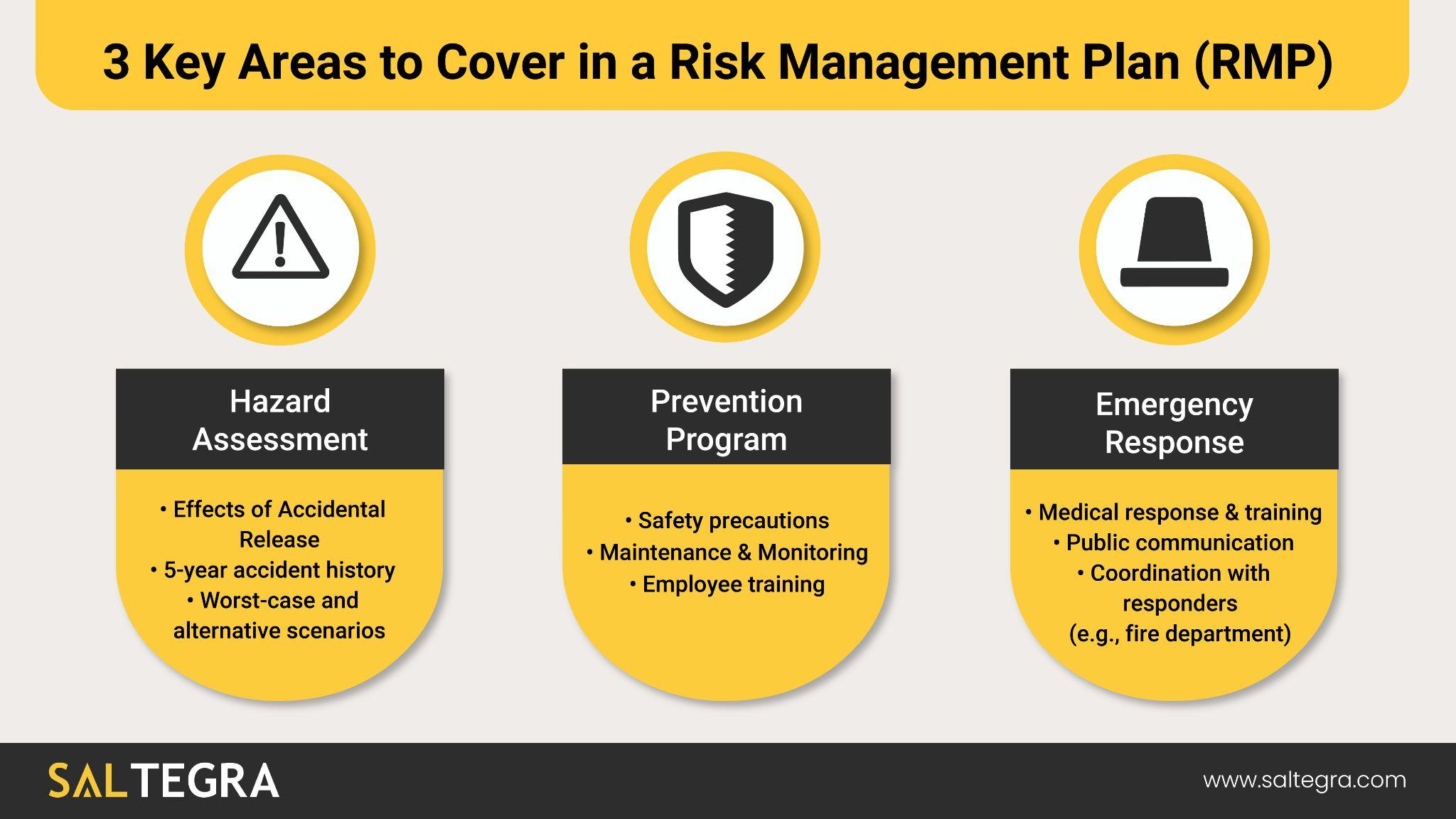
Major Components of a Risk Management Plan
Approach and Methodology
The methodology section defines the structured process used to identify, evaluate, and mitigate chemical hazards. Facilities often employ Process Hazard Analysis (PHA) methods such as HAZOP, What-If Analysis, and Fault Tree Analysis, along with consequence modeling (for toxic releases, fires, and explosions), Quantitative Risk Assessment (QRA), and Layer of Protection Analysis (LOPA), depending on process complexity and potential severity.
Implementation Note: The selected methodology must be appropriate for the complexity of processes and the severity of potential consequences. Documentation should include technical justifications for chosen approaches.
Risk Management Budget
The RMP budget allocation represents a critical investment in operational integrity and must account for:
- Engineering controls and process safety improvements
- Training program development and implementation
- Monitoring and detection equipment
- Documentation system development
- Drill and exercise execution
- Third-party auditing and verification
Strategic Consideration: Budget allocation should correspond to risk levels, with higher-risk processes receiving proportionally greater resources. Organizations should document cost-benefit analyses for major risk reduction expenditures.
Roles and Responsibilities
Clear delineation of responsibilities ensures systematic implementation and accountability:
- RMP Coordinator: Oversees program development, implementation, and reporting
- Process Safety Manager: Coordinates technical aspects of hazard analysis and prevention
- Operations Management: Ensures adherence to safe operating procedures
- Emergency Response Coordinator: Develops and tests response protocols
- Training Coordinator: Develops and delivers required training programs
- Legal/Compliance Officer: Ensures regulatory requirements are met
Documentation Requirement: Position descriptions should include specific RMP responsibilities, required qualifications, and performance metrics related to risk management activities.
Risk Response Plan
The response plan outlines specific actions to prevent incidents and minimize consequences when prevention fails:
- Engineering controls (containment systems, pressure relief devices)
- Administrative controls (operating procedures, permit systems)
- Detection and monitoring systems
- Emergency shutdown procedures
- Communication protocols
- Evacuation procedures
- Community notification systems
Regulatory Requirement: Response plans must be coordinated with Local Emergency Planning Committees (LEPCs) and include provisions for public notification per EPA guidelines.
Risk Register
The risk register serves as the master documentation of identified hazards, assessed risks, and control measures:
- Process description and chemical inventories
- Maximum intended inventories of regulated substances
- Process parameters (temperature, pressure, flow rates)
- Safety systems and their specifications
- Identified failure scenarios
- Risk assessments for each scenario
- Preventive measures implemented
- Verification of control effectiveness
Best Practice: The risk register should be maintained as a living document, regularly updated through the Management of Change procedures and findings from incidents and near-misses.
Probability and Impact Matrix
This matrix provides a standardized methodology for risk evaluation and prioritization:
- Probability ratings based on historical data and engineering analysis
- Consequence categories (safety, environmental, community, financial)
- Risk tolerance thresholds
- Risk reduction targets
- Prioritization framework for resource allocation
Technical Note: Chemical handling operations should utilize industry-specific data for probability assessments rather than generic risk matrices. CCPS guidelines provide chemical industry-specific approaches for this evaluation.
4 Main Phases in Creating a Risk Management Plan
Risk Identification
This foundational phase involves the systematic identification of potential hazards associated with chemical handling operations:
Key Activities:
- Chemical inventory development and verification
- Process flow diagram development
- Process hazard analysis (PHA) execution
- Review of incident history and near-misses
- Examination of industry incident databases
- Consideration of external hazards (natural disasters, security threats)
Regulatory Requirement: Per 40 CFR §68.67, Program 3 facilities must conduct process hazard analyses using appropriate methodologies, such as What-If, Checklist, HAZOP, Fault Tree Analysis, or equivalent approaches.
Risk Assessment
Risk assessment quantifies the potential consequences and likelihood of identified hazards:
Key Activities:
- Worst-case scenario modeling as required by 40 CFR §68.25
- Alternative release scenario analysis per 40 CFR §68.28
- Consequence modeling using approved models (ALOHA, PHAST)
- Vulnerability zone mapping
- Population impact assessment
- Environmental impact evaluation
- Facility impact analysis
Technical Note: Assessment methodologies must conform to EPA’s “Risk Management Program Guidance for Offsite Consequence Analysis” and utilize appropriate dispersion models for the chemicals and processes involved.
Risk Mitigation
Mitigation involves implementing preventive and protective measures to reduce identified risks:
Key Activities:
- Engineering control implementation
- Development of standard operating procedures
- Training program execution
- Preventive maintenance system development
- Management of change procedures
- Pre-startup safety review protocols
- Contractor safety management
Compliance Note: Prevention Program requirements vary based on program levels established in 40 CFR §68.10, with Program 3 facilities requiring the most comprehensive prevention measures.
Risk Monitoring
In high-risk regions like California, undergoing a chemical safety risk management plan RMP compliance audit is a routine part of ensuring alignment with state and federal standards in the USA. Continuous monitoring ensures control measures remain effective over time:
Key Activities:
- Compliance audits (required at least every three years)
- Performance indicator tracking
- Incident investigation procedures
- Root cause analysis methodology
- Management review process
- Documentation management
- Trend analysis and reporting
Documentation Requirement: Per 40 CFR §68.200, facilities must retain records of PHAs, incident investigations, compliance audits, and related corrective actions for a minimum of five years.
Frequently Asked Questions
What Is an EPA Risk Management Plan?
The EPA Risk Management Plan (RMP) is a regulatory requirement under Section 112(r) of the Clean Air Act, codified in 40 CFR Part 68. It applies to facilities that handle, use, or store regulated substances above specified threshold quantities. For companies in the USA, the chemical safety risk management plan (RMP) must be submitted to the EPA with the following data:
- Facility registration information
- Hazard assessment results
- Prevention program documentation (for Program 2 or 3)
- Emergency response program (if applicable)
- Certification of plan accuracy
Legal Note: Failure to submit an RMP can result in civil penalties of up to $58,871 per day per violation (per 2024 penalty adjustments), as well as criminal penalties for willful violations.
How Often Should Companies Submit an RMP?
Companies must:
- Submit initial RMPs before process startup or introduction of regulated substances
- Update and resubmit RMPs at least once every five years
- Revise and resubmit within six months of changes requiring revised hazard assessments
- Update within six months of changes requiring revised off-site consequence analyses
- Submit corrections within 30 days of discovering errors
Compliance Advisory: The EPA’s Central Data Exchange (CDX) system is the mandatory electronic submission platform for RMP filings.
What Is a Strategic Risk Management Plan?
A Strategic Risk Management Plan extends beyond regulatory compliance to integrate risk management principles into organizational strategy and decision-making:
- Aligns risk management activities with business objectives
- Establishes risk tolerance thresholds based on corporate values
- Incorporates risk considerations into capital investment decisions
- Develops performance metrics for risk management effectiveness
- Creates mechanisms for continuous improvement
- Fosters a risk-aware organizational culture
Implementation Insight: Organizations that integrate strategic risk management principles experience better operational performance, enhanced stakeholder confidence, and improved resilience to disruptions.
Conclusion
A well-designed Risk Management Plan is more than a compliance document. It provides a structured framework for protecting employees, communities, and organizational assets. Facilities that implement comprehensive chemical safety risk management plans (RMP) gap assessments and programs in the USA, based on the methodologies discussed in this article, can achieve meaningful improvements in operational safety, regulatory performance, and community relations.
Developing and maintaining an effective RMP requires technical expertise, organizational commitment, and a focus on continuous improvement. By following a structured approach and partnering with experts like Saltegra Consulting LLC, organizations that handle hazardous chemicals can turn regulatory requirements into a foundation for operational excellence and long-term risk resilience. Talk to RMP professionals today!