Understanding the EPA Risk Management Plan (RMP)
Introduction
Every facility that handles highly hazardous chemicals in threshold quantities is subject to the Risk Management Plan (RMP) (Federal) requirement under the Clean Air Act. This mandate, administered through the EPA RMP program, is designed to prevent catastrophic chemical releases and minimize their impact on human health and the environment.
However, compliance with federal RMP requirements involves more than simply submitting a plan. Facilities must determine their correct program level, maintain accurate records, and ensure their submittals are up to date, especially as operations change over time.
This article guides you through the types of submittals required by the EPA’s risk management plan and explains how to determine which program level (1, 2, or 3) applies to your facility.
The Role of the EPA RMP Program
The EPA RMP program was created under Section 112(r) of the Clean Air Act and codified in 40 CFR Part 68. The Risk Management Plan (RMP) (Federal) is required for any facility that:
- Uses a regulated substance
- At or above its threshold quantity
- In a process that could result in accidental release
Facilities must not only develop but also submit and regularly update their RMP through the EPA’s RMP*eSubmit system. Compliance includes hazard analysis, emergency response coordination, and a formal prevention program, depending on the designated program level.
When and How to Submit an RMP
Once a facility is covered under the federal requirements for RMP, it must submit a Risk Management Plan through the EPA’s electronic portal. Submissions are not one-time—they are ongoing and tied to operational or regulatory changes.
When Are RMP Submittals Required?
- Initially, when the facility becomes subject to the rule
- Every five years, regardless of changes
- After any significant change, such as a new process or chemical
- Following an accident, especially one with offsite consequences
Types of Risk Management Plan EPA Submittals
Understanding what kind of submission is needed—and when—is crucial for maintaining compliance with the risk management plan EPA regulations. There are five primary types of RMP submittals.
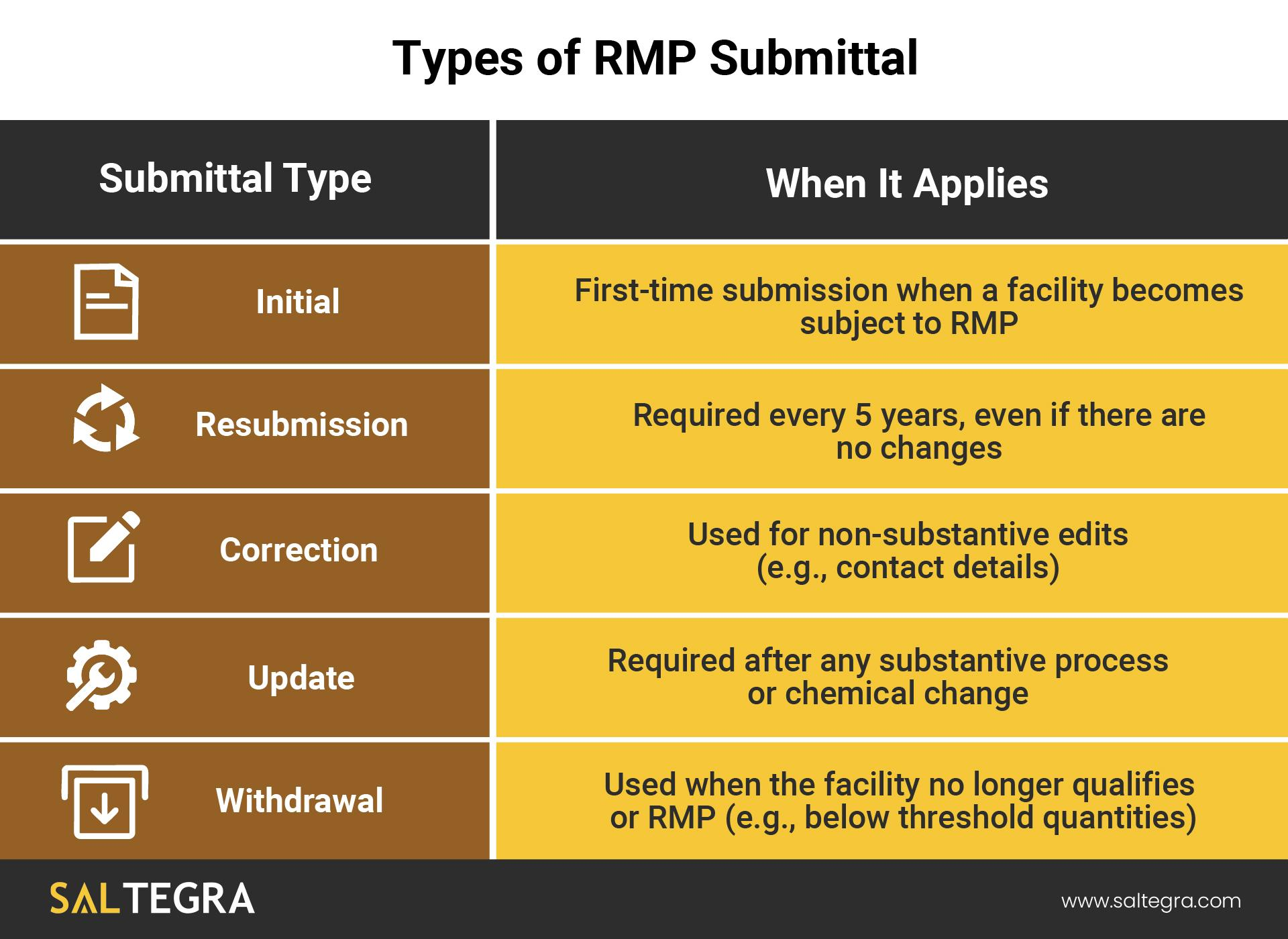
Each submission must reflect the correct program level for each regulated process.
Understanding EPA RMP Program Levels
The EPA RMP program employs a tiered structure comprising three program levels, each based on complexity and risk. The level assigned impacts the scope of hazard analysis, prevention measures, and emergency preparedness.
Program Level 1 – Streamlined Requirements
Eligibility:
- No accidental releases with offsite impact in the past 5 years
- Worst-case release does not impact any public receptors
- Facility coordinates with local emergency responders
Requirements:
- Basic worst-case scenario modeling
- Emergency coordination
- Five-year accident history
Typical Facilities:
- Remote water treatment systems
- Small agricultural chemical storage sites
Program 1 facilities enjoy streamlined requirements; however, few facilities qualify due to proximity to public areas or process risks.
Program Level 2 – Moderate Requirements
Eligibility:
- Not eligible for Program 1
- Not subject to OSHA’s Process Safety Management (PSM) standard
- Moderate operational complexity
Requirements:
- Hazard review (basic process hazard analysis)
- Written operating procedures
- Employee training
- Maintenance system
- Incident investigation
- Compliance audits every 3 years
- Emergency response coordination
Typical Facilities:
- Cold storage with ammonia refrigeration
- Bulk chemical distributors
Program 2 covers many facilities under the federal requirements for RMP, particularly those that handle dangerous chemicals but lack formal PSM oversight.
Program Level 3 – Highest Requirements
Eligibility:
- Subject to OSHA PSM
OR - Operates under certain high-risk NAICS codes (chemical manufacturing, petroleum refining, etc.)
Requirements:
- Full process hazard analysis (e.g., HAZOP)
- Management of Change (MOC)
- Mechanical integrity programs
- Pre-startup safety reviews
- Employee participation programs
- Emergency response plans
- Incident investigation with root cause analysis
Typical Facilities:
- Refineries
- Chemical manufacturers
- Chlorine or propane distribution terminals
Program 3 facilities face the most intensive documentation and oversight under the Risk Management Plan (RMP) (Federal) framework.
How to Determine Your Program Level
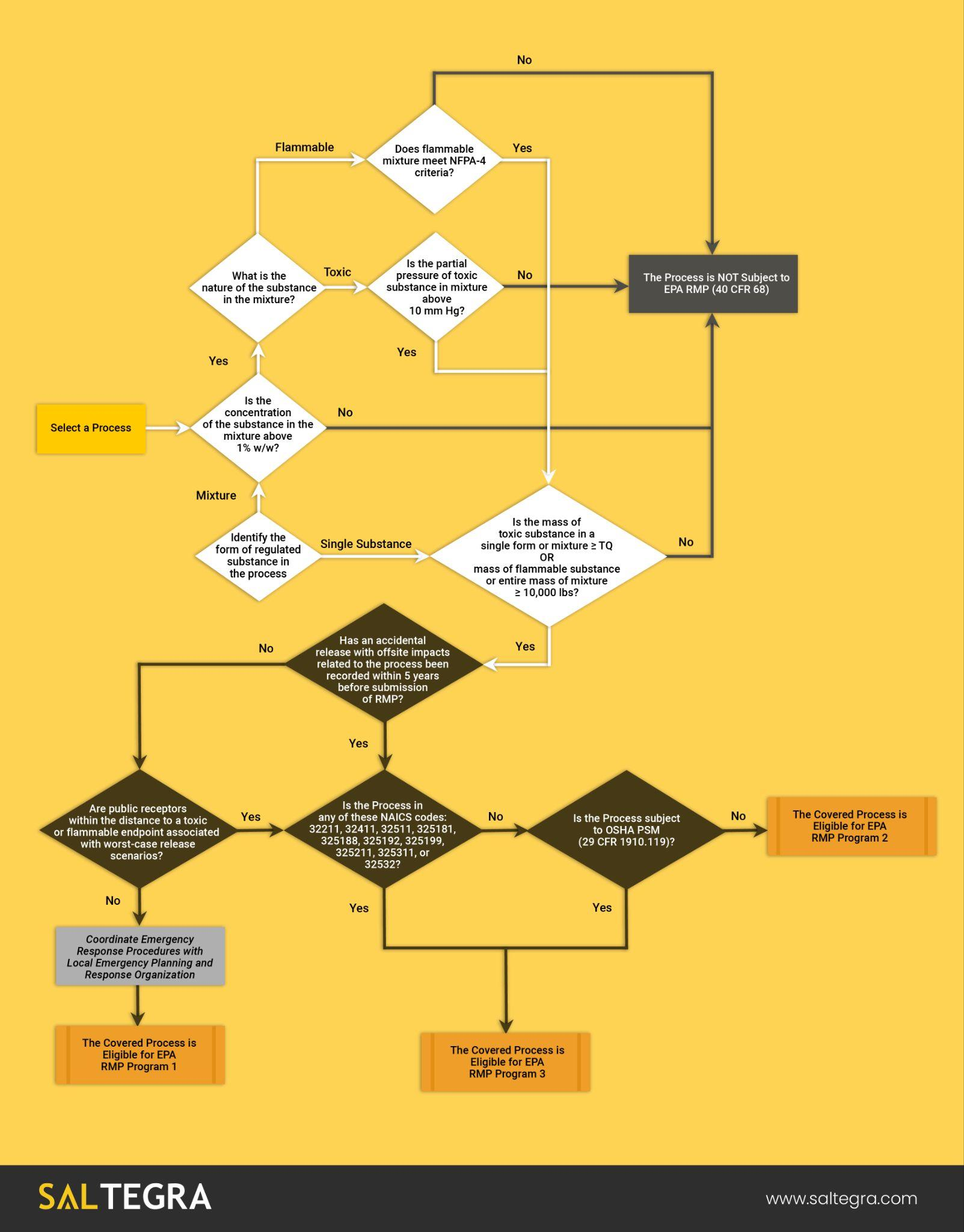
To determine your EPA Risk Management Plan (RMP) program level, begin by checking if your facility is subject to OSHA’s Process Safety Management (PSM) standard. If it is, then your facility falls under Program 3. If not, the next step is to assess whether your worst-case release scenario could impact the public. If it does not, and your facility has no reportable accidents in the past five years and has coordinated emergency response with local responders, then you qualify for Program 1. If the worst-case scenario does have potential public impact, proceed to the final step: check whether your facility is in a listed NAICS code associated with higher-risk industries (such as petroleum refining or chemical manufacturing). If it is, your facility is assigned to Program 3. If this is not the case, you fall under Program 2.
Tip: Program level determination is process-specific, not facility-wide. One facility can have processes under multiple program levels.
Staying Compliant Beyond Submittals
Submitting an RMP that meets the federal requirements for RMP is only the beginning. Facilities must ensure:
- Their data in RMP*eSubmit is up to date
- Prevention programs are implemented and documented
- Emergency response is coordinated with local responders
- A resubmission is prepared at least every five years
Additionally, the EPA’s 2024 RMP rule updates include new expectations around:
- Safer Technologies and Alternatives Analysis (STAA)
- Root cause analysis for incidents
- Enhanced emergency response coordination
- Community notification and public availability of information
Conclusion
For facilities subject to the Risk Management Plan (RMP) (Federal), understanding the different types of submittals and determining the correct program level is crucial for achieving and maintaining compliance.
Whether you’re submitting an RMP for the first time or renewing your plan, the key is to ensure it reflects the current risks and operations of your facility. From Program 1’s streamlined pathway to Program 3’s full PSM alignment, the EPA’s approach is risk-based and increasingly stringent.
Staying ahead of the EPA RMP program requirements ensures not only legal compliance but also operational resilience. At Saltegra Consulting, we help facilities across the U.S. navigate RMP classification, submittal, and post-submittal support, ensuring they meet every standard under the EPA’s risk management plan framework. Contact us today!