How to Ensure Compliance to Federal Regulations Using Compliance Audit
Introduction
In the chemical and manufacturing sectors, compliance audits under OSHA’s Process Safety Management (PSM) standard and the EPA’s Risk Management Plan (RMP) rule are crucial for ensuring safe operations and preventing catastrophic events. These federally mandated audits help facilities verify that their process safety systems are working as intended, meet legal requirements, and reduce the risk of major chemical incidents.
This article by Saltegra Consulting outlines the regulatory foundations of PSM/RMP federal compliance audits, interprets core requirements, and provides actionable strategies to prepare for, execute, and follow through on these audits.
Regulatory Bodies and Governing Standards
1. OSHA’s Process Safety Management (PSM) Standard (29 CFR 1910.119)
The Occupational Safety and Health Administration (OSHA) regulates workplace safety for facilities that handle highly hazardous chemicals (HHCs) at or above threshold quantities. The PSM standard comprises 14 interrelated elements designed to prevent chemical releases that could endanger workers.
Key audit-related requirement:
“Employers shall certify that they have evaluated compliance… at least every three years… and identify and document deficiencies and the corrective actions taken.”
(29 CFR 1910.119(o))
A compliance audit under PSM must be conducted every three years, and the audit team must include at least one person knowledgeable in the process.
2. EPA’s Risk Management Plan (RMP) Rule (40 CFR Part 68)
The Environmental Protection Agency (EPA) enforces the RMP rule to prevent chemical accidents that can affect public health and the environment. Facilities with processes that fall under Program 3 requirements must maintain a Risk Management Plan that includes:
- Hazard assessments
- Prevention programs
- Emergency response strategies
Like OSHA, the EPA mandates that RMP-covered facilities conduct compliance audits every three years and retain audit records, document findings, and ensure that corrective actions are tracked to completion.
Understanding Federal Audit Requirements
While both PSM and RMP audits share similarities in timing and structure, they differ slightly in their focus.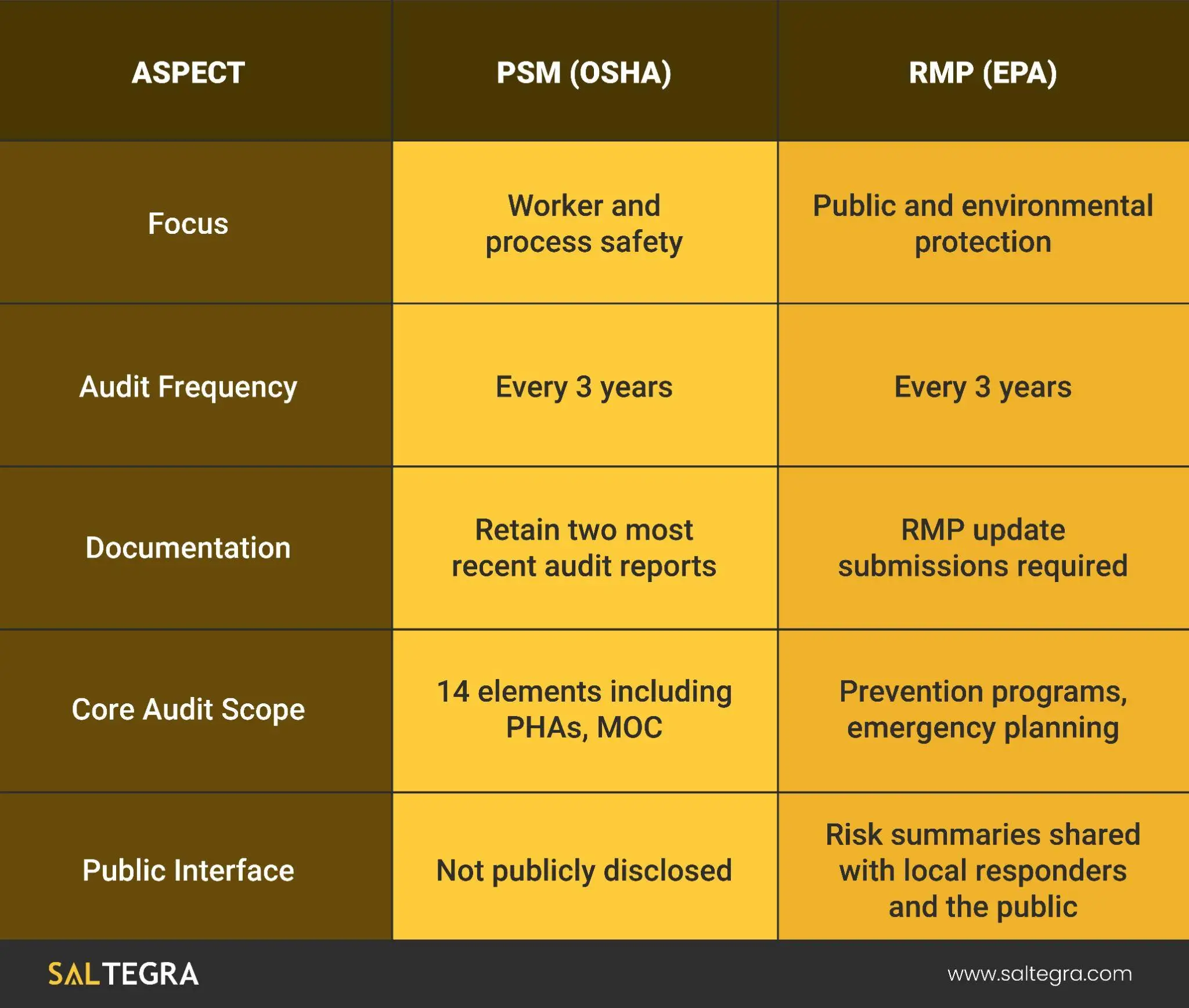
Although many requirements overlap, RMP adds obligations such as coordination with emergency responders and public communication, which are not included in PSM.
Key Components of a PSM/RMP Compliance Audit
A complete federal compliance audit should include the following:
- Regulatory Alignment
Confirm that the facility’s written safety programs address all applicable elements under both PSM and RMP federal compliance audits. This includes clear documentation of policies for PHAs, mechanical integrity, operating procedures, and other relevant information. - Documentation Review
Examine process safety information (PSI), previous audits, incident investigations, employee training records, and operating procedures. - On-Site Evaluation
Conduct physical inspections of systems and equipment, observe operations, and interview personnel to assess real-world compliance. - Corrective Action Planning
Identify deficiencies, assign responsibility, set deadlines, and track progress. Ensure that all issues are closed and verified within a reasonable timeframe.
Strategies for Achieving and Maintaining Compliance
1. Pre-Audit Preparation
- Conduct Gap Assessments
Perform internal evaluations using frameworks such as CCPS’s Risk Based Process Safety to compare current practices against OSHA and EPA expectations. This helps facilities identify gaps and resolve them before a formal audit is conducted. - Assemble a Cross-Functional Team
Bring together individuals from engineering, operations, maintenance, and safety to provide a complete perspective during audit planning and execution. - Update Documentation
Ensure all PSI, training records, and inspection reports are current, organized, and accessible.
2. Audit Execution
- Use Standardized Checklists
Rely on OSHA’s PSM audit checklist and EPA’s RMP audit protocol to guide evaluations. These tools help ensure that no required elements are overlooked. - Focus on High-Risk Areas
Give special attention to elements that commonly contribute to major incidents, including mechanical integrity, management of change (MOC), and emergency response planning. - Engage Employees
Interview frontline workers and supervisors. Their firsthand knowledge often reveals whether procedures are followed in practice.
3. Post-Audit Follow-Through
- Conduct Root Cause Analysis
For each deficiency identified, look beyond symptoms to find systemic issues. For example, missing training records may signal ineffective onboarding processes. - Implement a Tracking System
Utilize audit management software or structured spreadsheets to track open actions, assign responsible parties, set due dates, and monitor completion status. - Communicate Findings
Share results with management and staff. Use findings as training opportunities and reinforce safety expectations across the organization.
Common Pitfalls and How to Avoid Them
Pitfalls
- Incomplete or outdated documentation
Old operating procedures, missing PHAs, or unverified inspection records can all lead to findings and potential regulatory action. - Insufficient audit scope
Audits that focus solely on documentation and overlook field conditions often fail to identify actual compliance gaps. - Lack of employee engagement
Omitting worker participation often means the audit misses practical insights and procedural breakdowns. - Delays in corrective actions
Unresolved issues or unclear follow-up procedures weaken the effectiveness of the audit program.
Best Practices
- Schedule audits well before deadlines
This allows time to address findings and avoid last-minute pressure. - Use third-party reviewers
Engage qualified external auditors, especially for RMP audits, to provide unbiased assessments. - Benchmark against industry guidance
Compare your program to best practices outlined in AIChE’s Guidelines for Risk-Based Process Safety or similar resources. - Integrate audits into your management system
Connect audit outputs with broader safety initiatives, such as process hazard analysis updates or MOC reviews.
Conclusion
PSM and RMP federal compliance audits are more than routine inspections. They are essential tools for identifying deficiencies, strengthening safety systems, and meeting federal expectations. These audits support operational reliability, legal compliance, and public trust.
By aligning internal practices with OSHA and EPA standards, preparing through detailed gap assessments, and maintaining a culture of continuous improvement, organizations can reduce their risk exposure and enhance safety performance. As federal requirements evolve, proactive compliance remains the most effective strategy for achieving sustainable process safety.
For PSM and RMP compliance audit assistance, feel free to contact experts like Saltegra Consulting to guide you in the process.