The Role of HAZID Study in the Implementation of Effective Control Measures
Introduction
Before any control measure can be designed, installed, or implemented, organizations must first ask: What are the hazards? This question is at the core of every successful hazard identification and risk assessment process. One of the most practical and widely accepted methods for addressing this—especially in the early stages of a project or for lower-complexity operations—is the Hazard Identification (HAZID) study.
HAZID provides a high-level overview of potential risks across systems, operations, and environments. It helps teams recognize early exposures, spot design issues, and plan effective safeguards long before detailed engineering or construction begins. Importantly, the outcomes of a HAZID study guide the development of hazard identification and control measures that are both realistic and effective.
This article explains how HAZID works, its crucial role in process safety, and how it directly supports the implementation of effective controls that protect people, the environment, and assets.
How HAZID Identifies Hazards Early in the Process
A HAZID study is a structured brainstorming session conducted by a multidisciplinary team. Guided by experienced facilitators and standardized prompts, the team explores the full range of risks, from chemical hazard identification to environmental and human factors, ensuring a comprehensive understanding of the risks associated with the project.
Unlike detailed methods like HAZOP, which require finalized process data, HAZID is more flexible and can be conducted even when the system is still in the concept or pre-feed stage. It helps identify potential hazards such as:
- Uncontrolled releases of flammable or toxic chemicals
- Interface risks between new and existing systems
- Equipment layout or accessibility issues
- Lack of separation between hazardous and occupied areas
- External risks like flooding, lightning, or vehicle impact
By starting early, organizations can make cost-effective changes before systems are locked in, such as modifying equipment location, changing materials of construction, or updating ventilation strategies. This is critical in moving from identification to action—early insights lead to safer designs.
HAZID Study Roadmap
Here is a simplified roadmap that shows how a HAZID study fits within the broader hazard identification and risk assessment process:
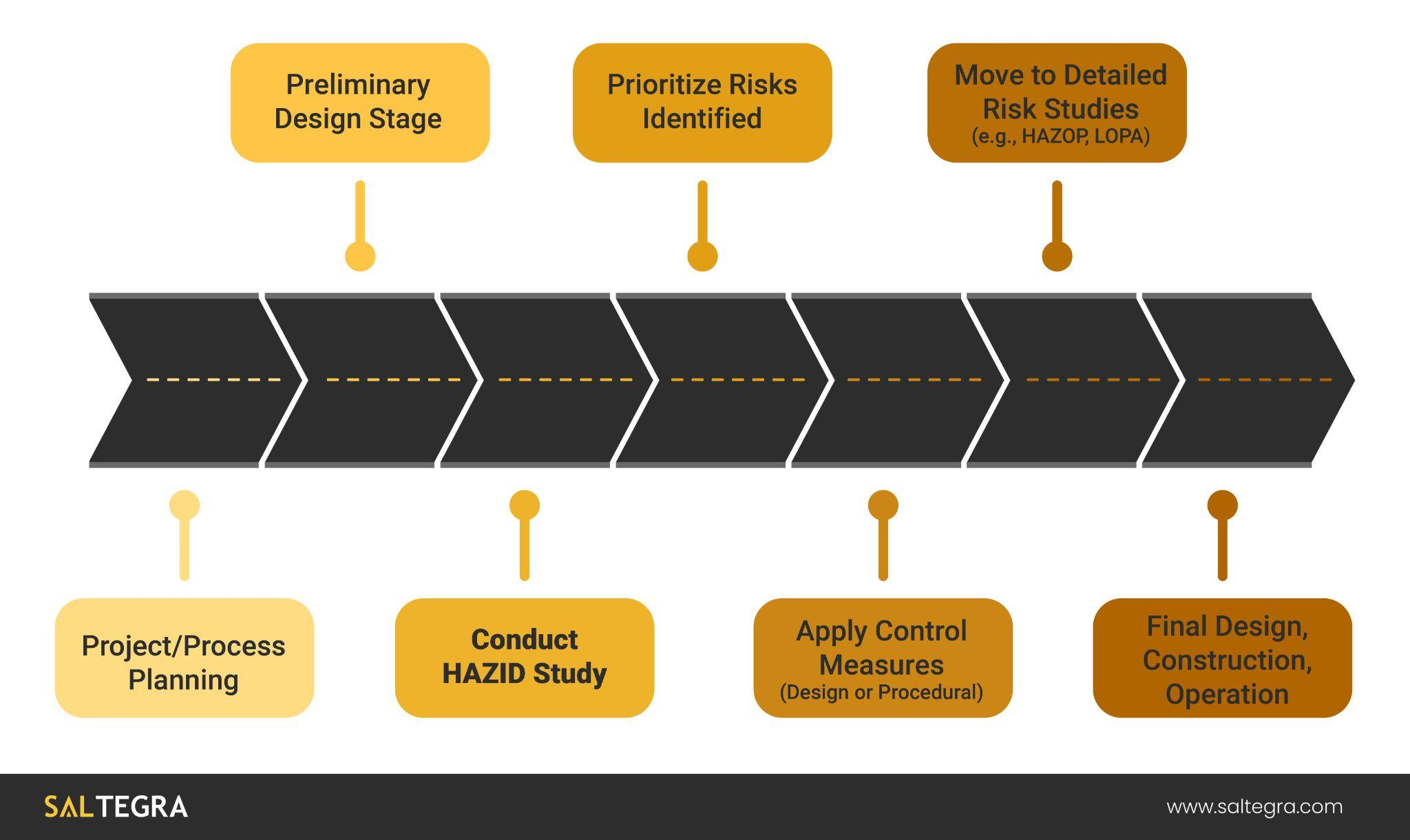
This roadmap highlights HAZID’s place as the first structured risk screening activity that informs all downstream decisions.
Role of HAZID in Safety and Compliance
Supports Legal and Industry Compliance
Regulatory bodies like OSHA (in the U.S.) and global standards from CCPS emphasize the importance of hazard identification in preventing major incidents. While detailed PHAs are required under standards such as OSHA 1910.119 and the EPA’s Risk Management Plan rule, industry best practices accept HAZID as an appropriate method for lower-risk systems or as an initial risk assessment before more in-depth studies.
In industries such as oil and gas, pharmaceuticals, and chemicals, clients and regulators expect hazard identification and control measures to be documented and traceable to a formal method. A HAZID fulfills this role by identifying credible hazards and documenting the team’s rationale for the chosen safeguards.
Reinforces a Proactive Mindset
Rather than reacting to audits, incidents, or design flaws discovered during construction, HAZID shifts the conversation earlier. It creates a platform for engineering, operations, and safety professionals to collaborate in identifying risks and resolving them before they become embedded in a system.
In this way, HAZID promotes a preventive mindset. Teams don’t wait for red flags—they look for them, even when nothing has gone wrong yet. It also encourages the review of external risks, human factor issues, and chemical hazard identification problems that might otherwise be missed in standard process reviews.
Improves Documentation and Traceability
Every finding from a HAZID session is documented, categorized, and linked to recommended actions or justifications. These findings become part of the permanent design and safety record for the system or facility. In many cases, they are later referenced during HAZOPs, Management of Change (MOC) processes, Pre-Startup Safety Reviews (PSSRs), or audits.
This documentation improves transparency and provides evidence that decisions were made with due diligence, whether the hazard was accepted, mitigated, or escalated for further analysis.
From Hazard Identification to Control Measures
The strength of a Hazard Identification (HAZID) study is not in the number of hazards it lists, but in how well those hazards are understood and managed. Once a hazard is identified, it must be evaluated for risk and addressed with a control that reduces either the likelihood, the consequence, or both.
Common hazard identification and control measures developed from HAZID findings include:
- Engineering controls like pressure relief systems, containment bunds, or remote shutoff valves
- Administrative controls such as revised operating procedures, signage, or exclusion zones
- Equipment redesigns to improve access or reduce exposure
- Updated inspection or maintenance schedules for critical components
- Relocation of equipment away from populated or vulnerable areas
For example, during Saltegra’s Hazard Identification (HAZID) study for a new blending facility handling fine organic powders, the design team presented the preliminary process description and conceptual layout. The system included powder charging into a closed blender via vacuum transfer from a storage hopper. At this point, P&IDs were still in development, and material properties had been characterized but not yet fully evaluated from a fire and explosion perspective.
As part of the HAZID, the team discussed possible ignition scenarios during powder transfer and mixing. Operators highlighted the presence of dry product dust clouds and the mechanical energy introduced by the blender. The team flagged the potential for static discharge ignition in a flammable dust atmosphere, especially since the vessel was originally designed to operate on air.
The discussion triggered further evaluation of the chemical hazard identification data. The minimum ignition energy (MIE) of the powder was found to be low, and the minimum explosible concentration (MEC) could easily be reached under the planned process conditions.
As a result, the team recommended the following hazard identification and control measures:
- Replace air with nitrogen as the operating and blanketing medium
- Ensure the blender and transfer equipment are properly bonded and grounded
- Specify explosion venting or suppression based on dust hazard analysis
- Conduct a full combustible dust Hazard Assessment as part of the detailed design
Because this concern was captured during the hazard identification and risk assessment stage of basic engineering, the process design was revised early enough to avoid costly redesigns or retrofitting. More importantly, a serious deflagration risk was mitigated before the hazard became embedded in the system.
Conclusion
The Hazard Identification (HAZID) study is a crucial early tool for understanding and mitigating risk. It forms the foundation of an effective hazard identification and risk assessment strategy, especially when systems are still evolving or when quick decisions are needed for projects with limited complexity.
By identifying a wide range of hazards—technical, chemical, human, and environmental—HAZID supports organizations in selecting and implementing control measures that are practical, timely, and defensible. It also reinforces a culture of prevention, positioning teams to take action before problems arise.
At Saltegra Consulting, we guide clients through HAZID studies that not only meet industry best practices but also deliver real, usable insights. From chemical hazard identification to facility layout improvements, our focus is on helping you move from awareness to action with clarity and confidence.
If you are in the early stages of design or preparing for a safety review, now is the right time to conduct a HAZID. It is not just about identifying hazards—it’s about ensuring those hazards never escalate into incidents. Contact Saltegra Consulting today!