

An Introduction to HAZID: What Is This Technique and How Does It Work?
Introduction
Hazard Identification (HAZID) is a structured brainstorming process conducted in a team setting to identify potential hazards early in a project’s design phase. It is the initial step in hazard identification/HAZID and risk analysis in the USA, preceding more detailed studies such as Process Hazard Analysis (PHA) or Hazard and Operability Study (HAZOP). HAZID focuses on both process-related hazards and external threats that could impact facility safety, including environmental risks, human factors, and potential sources of significant accidents.
Typically used in the conceptual and early design stages, HAZID supports inherently safer design (ISD) by identifying and addressing hazards before they become embedded in the project. It applies to new facilities, major projects, modifications, and operational changes. The study is guided by a structured approach that uses hazard keywords to systematically examine each area, system, or activity, ensuring comprehensive hazard recognition.
While HAZID identifies potential risks and sets the foundation for further safety assessments, it does not analyze process deviations in detail. That level of scrutiny is reserved for HAZOP, which occurs at a later stage to evaluate specific deviations and their consequences. By implementing HAZID early, organizations can proactively shape safer, more cost-effective designs while guiding future risk mitigation efforts.
What Are the Advantages of Conducting a HAZID Study?
HAZID ensures early hazard identification, preventing costly redesigns and last-minute risk mitigation efforts. Addressing both inherent and external hazards at the conceptual stage streamlines the safety review process and sets a strong foundation for subsequent studies like HAZOP and PHA.
This structured approach enhances efficiency by focusing on broad hazard categories while reserving detailed process deviation analysis for HAZOP. As a result, HAZID minimizes redundant discussions, allowing teams to allocate resources effectively and ensure a more targeted and productive risk assessment later in the project.
Additionally, HAZID supports ISD by identifying opportunities to eliminate or reduce hazards before they become embedded in the system. This proactive approach leads to safer, more cost-effective designs while optimizing project timelines.
How Does HAZID Compare to Other Hazard Analysis Techniques?
HAZID vs HAZOP
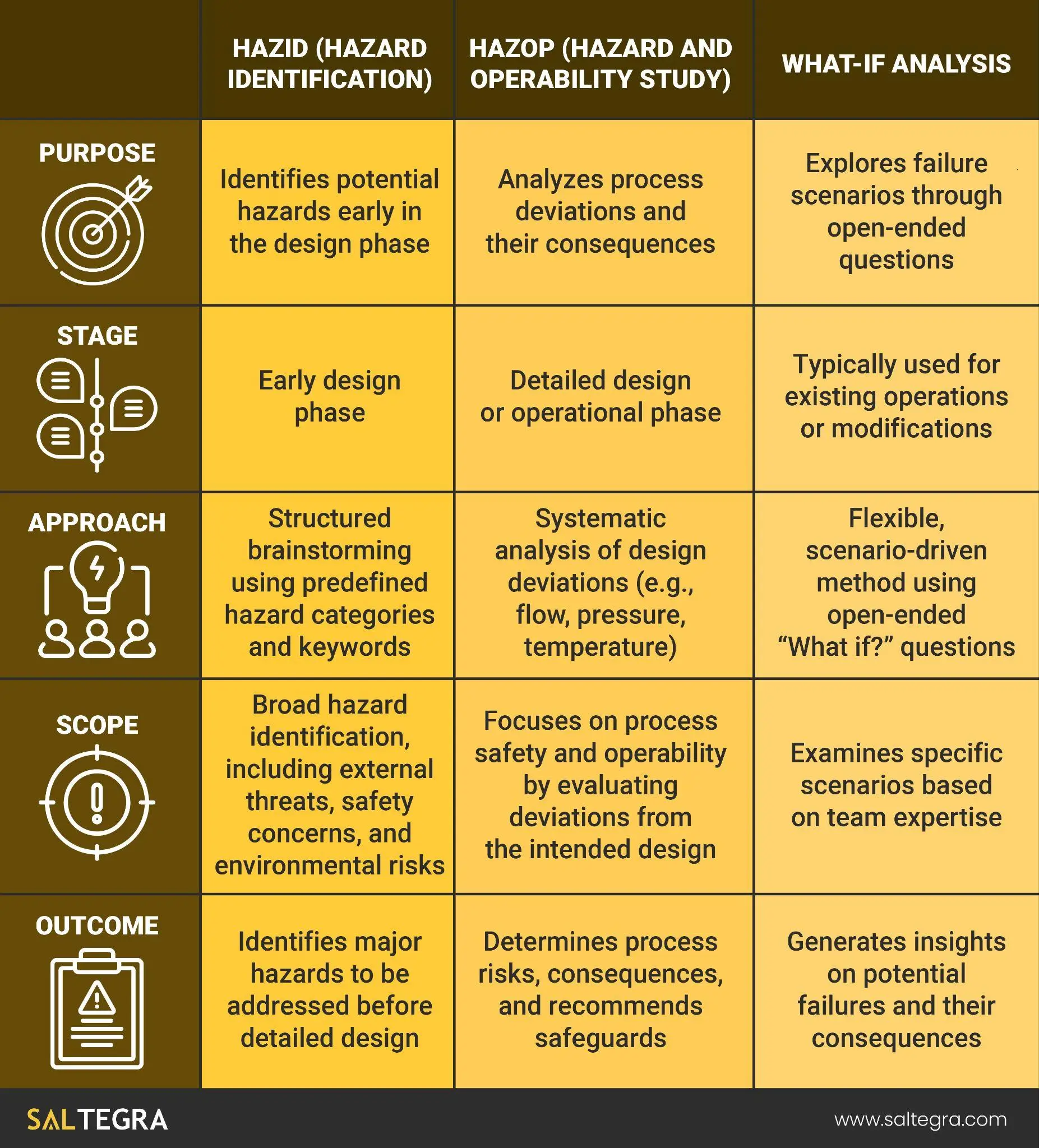
HAZID and HAZOP are both systematic methods for hazard identification (HAZID), but they serve different purposes and occur at different project stages. HAZID is a high-level brainstorming process conducted in the early design phase to identify potential hazards—including external threats, safety concerns, and environmental risks—before they are embedded in the project. It focuses on broad hazard categories using structured keywords, ensuring critical risks are recognized and addressed before moving to detailed design.
In contrast, HAZOP is a more detailed and structured analysis performed later in the project, typically during the detailed design or operational phases. It focuses on process deviations by systematically analyzing how variations in design parameters (e.g., flow, pressure, temperature) could lead to hazardous scenarios. While HAZID identifies major hazards, HAZOP determines how specific process deviations could lead to those hazards and recommends safeguards.
HAZID vs What-Ifs
While both HAZID and What-If Analysis are qualitative techniques used in PHA, they differ in structure and application. HAZID follows a systematic and structured approach, using predefined hazard categories and keywords to ensure comprehensive hazard identification (HAZID) across an entire system or process. It’s primarily used early in the design phase to capture a broad range of potential risks before they escalate into major design challenges.
What-if analysis, on the other hand, is a more flexible and scenario-driven method. It relies on open-ended questions to explore potential failures and consequences. Rather than using structured keywords, it encourages subject-matter experts to anticipate deviations by asking, “What if this happens?” This makes it practical for existing operations or modifications where brainstorming around specific scenarios is more useful.
While HAZID ensures systematic hazard identification across all project areas, What-If Analysis allows for a more dynamic exploration of specific risk scenarios based on team expertise.
When Is the Best Time To Conduct a HAZID Study?
HAZID is best conducted early in the project lifecycle, typically during the conceptual or front-end engineering design (FEED) stage. This ensures that potential hazards are identified before they become part of the design, allowing ISD principles to be incorporated from the start. Conducting HAZID at this stage helps avoid costly late-stage modifications and ensures that high-level risks are addressed before moving into detailed design and hazard analysis. HAZID may also be valuable for major projects, facility expansions, and significant modifications where new hazards may arise.
HAZID Process and Methodology
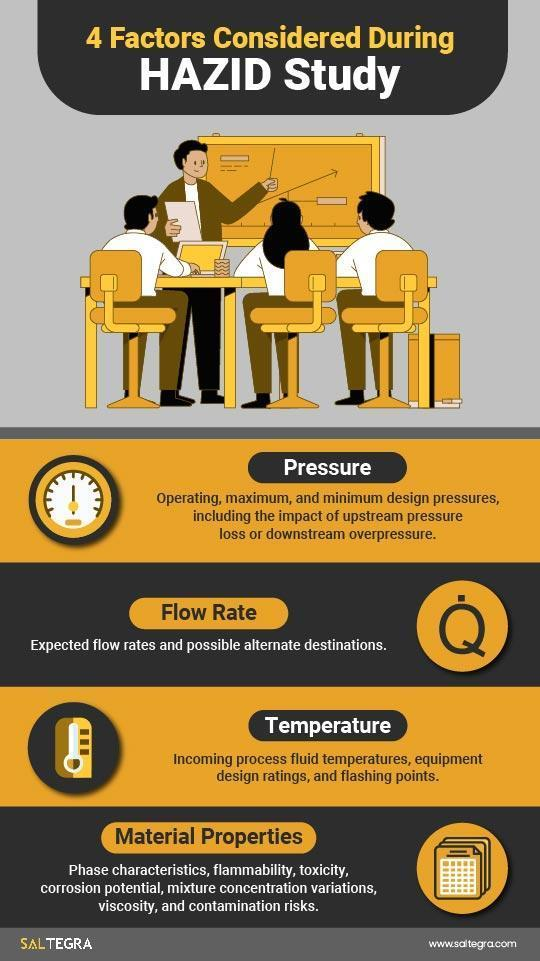
HAZID begins with selecting a study point or node from a predefined list. The lead process engineer describes its function and operation, including key parameters such as:
- Pressure – Operating, maximum, and minimum pressures, including the impact of upstream pressure loss.
- Flow Rate – Expected flow rates and possible alternate destinations.
- Temperature – Incoming process fluid temperatures, equipment design ratings, and flash points.
- Material Properties – Phase characteristics, flammability, toxicity, corrosion potential, mixture concentration variations, viscosity, and contamination risks.
Once the team clearly understands the node, HAZID guidewords are applied. External, environmental, and layout hazards are reviewed once for the entire facility using plot plans and block flow diagrams, while process-specific hazards are assessed for each node individually. Guidewords are used to identify potential hazards relevant to the unit systematically.
For each identified hazard, the team determines possible causes, such as equipment failure, corrosion, overpressure, or operator error. The severity of potential consequences is noted, followed by an evaluation of existing safeguards, including mechanical design, pressure relief devices, control systems, interlocks, maintenance procedures, administrative controls, and operator training.
The likelihood of occurrence is assessed by considering both the initiating events and the effectiveness of barriers in preventing the consequence. If the risk is excessive, recommendations are made to eliminate or mitigate the hazard. Inherently safer design options are prioritized before considering engineered safeguards or administrative controls to reduce the risk to an acceptable level.
 Common Challenges in HAZID Studies
Incomplete Data
Since HAZID is typically conducted in the early stages of a project, key process details may still be undefined or unavailable. This lack of information can limit the ability to identify hazards comprehensively, particularly in complex systems. To mitigate this, it is essential to involve a multidisciplinary team with expertise in different aspects of the process and to leverage historical data where possible.
Limited Experience
Effective HAZID requires a thorough understanding of process operations, external risk factors, and regulatory requirements. If the team lacks experienced personnel, critical hazards can be overlooked. Ensuring team members receive appropriate training and incorporating subject-matter experts into the review process can improve the study’s effectiveness.
Inadequate Documentation
Proper documentation is essential to track and address the hazards identified during HAZID. If findings and recommendations are not clearly recorded, key risks may be missed in later design stages or follow-up assessments like HAZOP. Standardized documentation practices help ensure continuity and accountability in the hazard management process.
Lack to Follow-Up
The value of HAZID depends on how well its findings are integrated into subsequent risk management activities. Without a structured follow-up process, identified hazards may not be addressed, reducing the study’s overall effectiveness. Establishing clear action plans and regularly reviewing mitigation efforts can help ensure that risks are properly managed.
Frequently Asked Questions
Who should be involved in a HAZID study?
A multidisciplinary team should participate, including process engineers, operations, safety, environmental, and maintenance personnel.
Can HAZID be used as a standalone hazard assessment tool?
Yes, but for process-intensive facilities, it is often followed by HAZOP, LOPA, or other risk assessments.
How long does a HAZID study take?
Depending on complexity, a HAZID study can take from a few days to several weeks.
How often should HAZID be performed?
HAZID is typically conducted once in the early design phase but may be repeated for major modifications or revalidations.
Conclusion
Hazard Identification (HAZID) is a vital first step in ensuring safer, more efficient, and well-designed processes by identifying hazards before they become costly issues. By proactively assessing risks early, organizations can prevent accidents, streamline safety efforts, establish a strong hazard identification (HAZID) study training in the USA, and lay the groundwork for more detailed hazard studies like HAZOP.
The success of HAZID studies relies on a well-structured approach, experienced hazard identification (HAZID) study facilitators, and a commitment to following through on findings. Investing in expert-led HAZID studies strengthens safety and drives smarter decision-making in project design and operations. To ensure your facility is on the right path, reach out to Saltegra Consulting for expert guidance in conducting a thorough and effective HAZID study.